


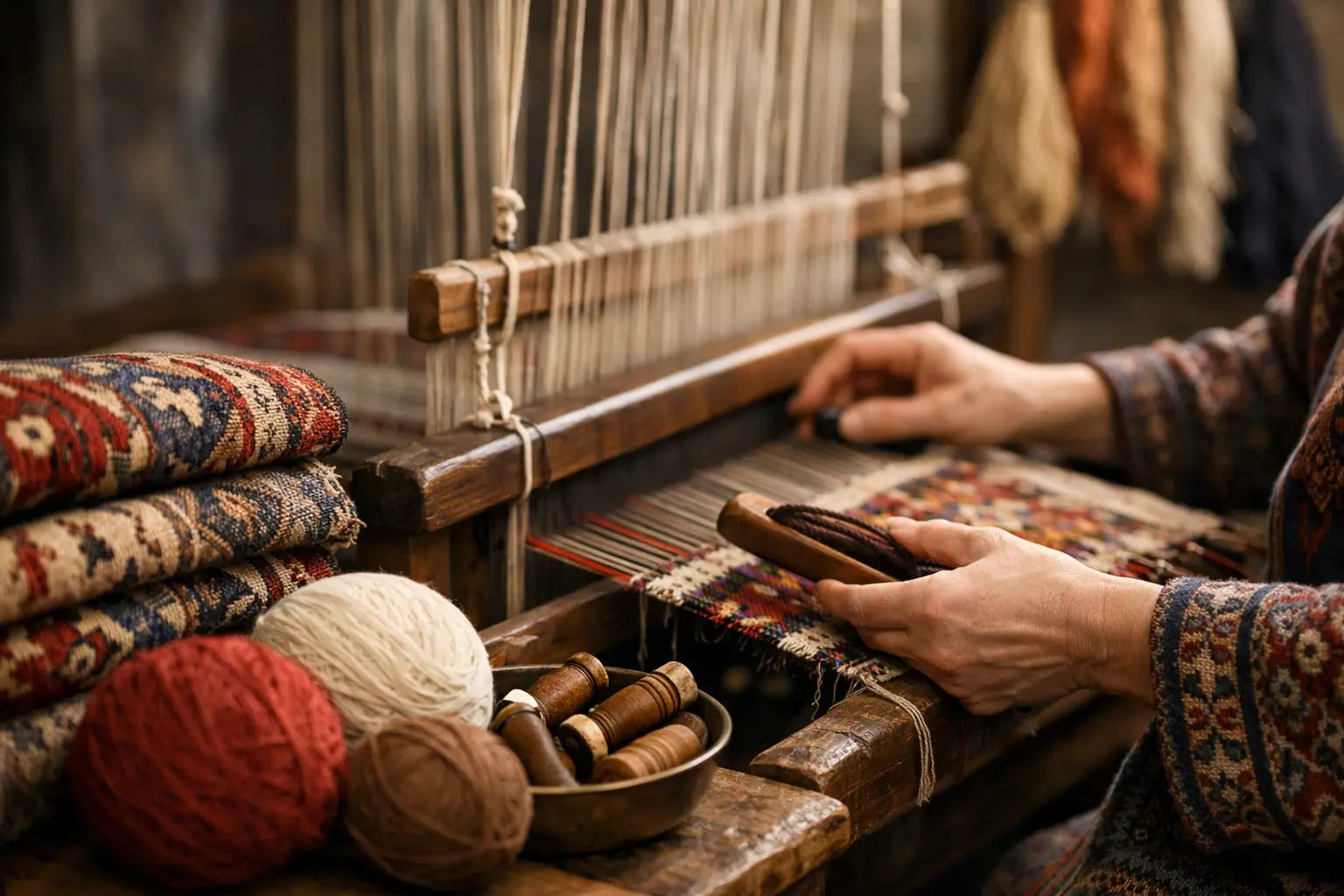
A handwoven textile changes a room before you have even named why. The light catches a raised motif, the weave holds its own quiet irregularity, and suddenly the space feels less arranged and more lived. That is the lasting power of Anatolian textile craftsmanship — not simply decoration, but material memory shaped by skilled hands, regional knowledge and a deep sense of home.
For those who care how a room feels as much as how it looks, textiles from Anatolia offer something rare. They carry the discipline of technique, the intimacy of touch and the elegance of pieces made to age with grace. In a market crowded with imitations of craft, their value lies precisely in what cannot be hurried: time, judgement and tradition.
What makes Anatolian textile craftsmanship distinct
Anatolia has never been a single visual language. It is a meeting point of regions, trade routes and domestic traditions, and its textiles reflect that richness. A peshtemal woven for daily ritual in the bath has a different purpose and handle from a decorative kilim cushion or a linen table covering intended for a long, generous lunch. Yet they share certain qualities — respect for fibre, clarity of pattern and a confidence in utility.
This is part of what makes Anatolian work so compelling in contemporary interiors. These pieces were not invented for trend cycles. They were made for use, for family life, for ceremonies, for dowries, for hospitality. Their beauty comes from function refined over generations.
There is also the question of touch. Machine-made fabrics may imitate the look of traditional weaving, but they rarely capture its tactility. In artisan textiles, the tension of the weave, the softness or crispness of the yarn, and the slight variation in finish all contribute to a richer visual presence. You notice it on a bed layered with hand-finished cotton, on a dining table softened by woven linen, or in a bathroom where a peshtemal feels both practical and quietly luxurious.
The materials behind Anatolian textile craftsmanship
The story begins with fibre. Cotton is central to many Turkish textiles, prized for its absorbency, softness and breathable character. Good cotton does not need to shout. It performs beautifully in daily life, whether woven into towels, robes or lightweight throws, and over time it often becomes even more inviting.
Linen brings another register altogether. It has a noble dryness to the hand and a natural drape that suits understated interiors. In the right weave, it lends structure without stiffness, which is why it feels so at home in table linens, cushions and bedroom layers where restraint matters as much as comfort.
Wool, of course, remains essential in rugs and heavier woven pieces. Its warmth is not only thermal but visual. A wool textile absorbs and reflects light in a way synthetics cannot, giving pattern depth and colour nuance. This matters especially in homes designed with a Mediterranean eye, where daylight is part of the decorative scheme.
Natural fibres do ask something of the buyer. They may crease, soften, shift slightly and show the character of use. For many discerning homes, that is the point. Perfection can look sterile; patina feels cultivated.
Weaving, embroidery and the art of restraint
When people speak of craft, they often picture ornament. Yet one of the most sophisticated aspects of Anatolian textile work is its balance. A striped peshtemal may appear simple at first glance, but its beauty depends on proportion, selvedge detail and the precision of the loom. An embroidered textile can carry centuries of visual heritage, but the finest examples never feel overworked.
This restraint is especially relevant to modern interiors. Not every room benefits from loud pattern or dense decoration. Often, the most memorable spaces are built through layers of texture and considered contrast — cool marble against woven cotton, glazed ceramic beside matte linen, polished brass near knotted wool. Anatolian textiles excel in this conversation because they offer pattern with discipline and softness with structure.
There is also a particular generosity in the making. Fringed edges, hand-finished seams and subtle motif variations are not defects to be corrected. They are signs that a person, not a production line, was responsible for the final form. For clients furnishing a principal residence, a coastal retreat or a boutique hospitality setting, that human presence changes the emotional register of the room.
Why these textiles suit contemporary European homes
European interiors often live between two instincts: an affection for comfort and a respect for understatement. Anatolian textiles sit beautifully in that space. They bring warmth without heaviness, colour without excess and craftsmanship without theatricality.
In a city apartment, a handwoven runner or cushion can soften architectural formality. In a countryside home or Mediterranean villa, striped cotton and tactile linen feel naturally at ease with stone, timber and painted cabinetry. By the coast, lighter weaves and sun-washed tones speak to the relaxed elegance many buyers want but rarely achieve with mass-produced pieces.
The appeal is not merely aesthetic. There is discernment in choosing textiles with provenance. Buyers at the premium end of the market are increasingly alert to the difference between a product designed to mimic heritage and one that truly comes from it. That does not mean every artisan piece is automatically superior. It does mean the best workshops offer a level of integrity, material intelligence and finish that mass production struggles to replicate.
How to recognise quality in artisan textiles
A beautiful photograph is not enough. Serious textile buying begins with attention to construction. Look first at fibre content, because the feel and longevity of a piece depend on it. Then consider the weave. Is it balanced, substantial and appropriate to its use? A towel should absorb well and dry efficiently; a table linen should sit elegantly without feeling flimsy; a cushion cover should have enough body to hold its shape.
Finish matters just as much. Edges, tassels, embroidery placement and closure details reveal care or its absence. Colour should feel integrated into the textile rather than printed on as an afterthought. And if a piece is handmade, small variations should appear harmonious, not careless.
There is, inevitably, a trade-off between absolute uniformity and authenticity. Handcrafted textiles may not match one another with factory precision. For some buyers, especially in highly controlled schemes, that can feel challenging. For others, it is exactly what gives a room soul. The key is to buy with intention. If you want every stripe perfectly identical, machine production may suit you better. If you want texture, nuance and a sense of origin, artisanal work is worth the choice.
Living with Anatolian textile craftsmanship
The finest textiles are not too precious to use. They become more persuasive in daily life — folded over the arm of a sofa, layered at the end of a bed, set across a table for a slow supper, hanging in a bath warmed by steam and light. They do not ask for a staged room; they reward a thoughtful one.
This is where curation matters. A home filled with artisan pieces should still feel edited. Too many strong textiles can compete with one another, particularly in smaller rooms. Often, one anchored statement and a few quieter supporting layers create the most elevated effect. A woven rug can ground the space while softer cottons and linens carry the rhythm elsewhere.
For buyers who value both heritage and refinement, this is the pleasure of sourcing well. Pieces made in workshops across Anatolia bring history into the home without turning it into a museum. They remain useful, tactile and utterly contemporary. At Casa Serena Interiores, that balance between cultural depth and modern elegance is precisely what makes artisan textiles so irresistible.
Perhaps that is why they endure. Not because they are old, but because they still answer the most intimate question any object in the home must meet: does it make daily life feel more beautiful, more grounded, more truly yours?


