


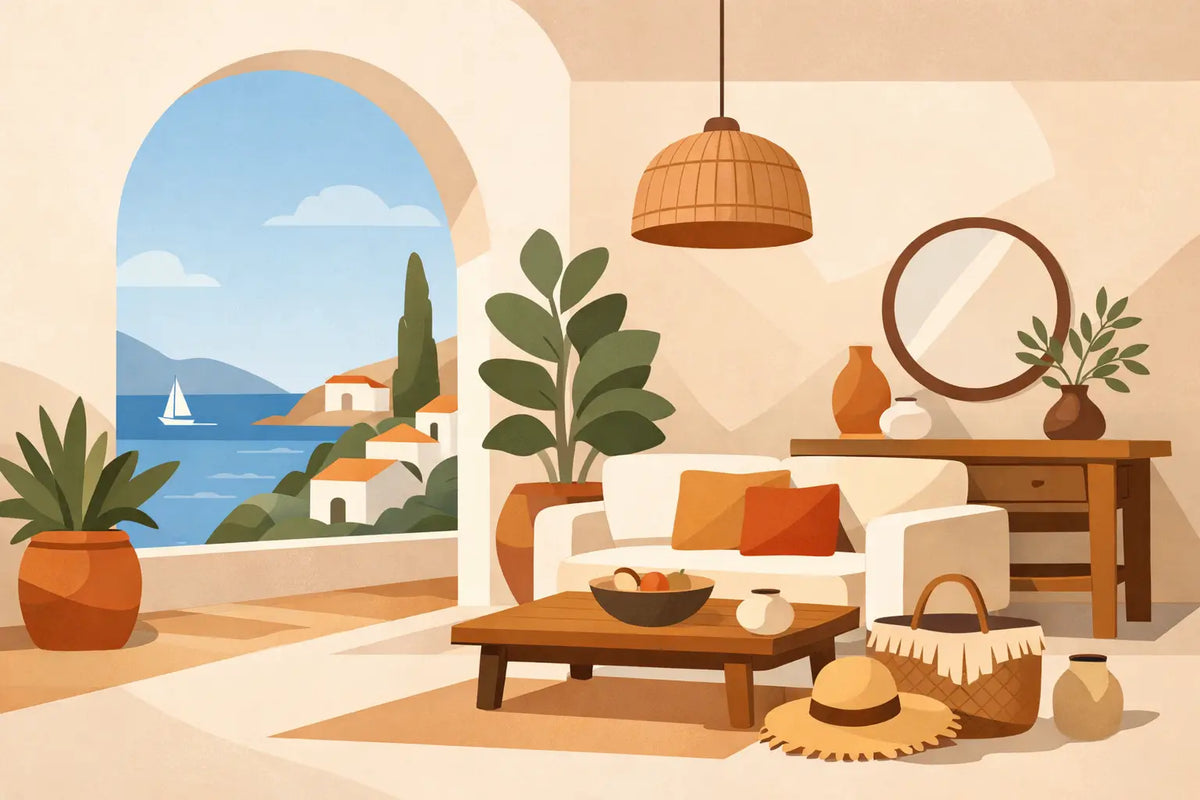
A sun-drenched room can have white walls and still convey nothing at all. The authentic Mediterranean style is not born from copying a coastal postcard or accumulating blue details: it is built with matter, proportion, light, and objects that preserve the touch of those who created them. It is a way of understanding the home as a luminous refuge, but also as an intimate collection of stories.
For those looking for a home far from impersonal decoration, its appeal lies precisely there. A ceramic bowl with irregular glaze, a hand-woven kilim rug, or a wrought-metal lamp do not fill a space: they grant it depth. What others call decoration, we call legacy.
What truly defines the Mediterranean style
The Mediterranean is not a uniform visual territory. The Greek islands, Italian coasts, the south of Spain, the Maghreb, Anatolia, and the Aegean coexist within it. Each place has left its mark on interiors through its pigments, textile techniques, ceramic crafts, and ways of living. That is why reducing this style to white, rattan, and navy blue is as convenient as it is superficial.
Its essence lies in a lived-in beauty. Surfaces do not need to look perfect, but honest: lime wash, wood with visible grain, washed linen, terracotta, stone, copper, and cotton. Light is not treated as an accessory either. It enters, filters through a light curtain, reveals textures, and changes the character of a room throughout the day.
The third element is hospitality. A well-resolved Mediterranean interior invites you to stay. There is a table that welcomes long conversations, a blanket within easy reach, generous seating, and objects that can be touched and used. Luxury, here, does not need to show itself with stridency. It is perceived in the weight of a piece, in the quality of a fiber, and in the time its creation required.
Craftsmanship is not a final detail
In too many interiors, artisanal objects are added when the project is finished, as if they were an exotic note. In a home with a Mediterranean sensibility, they must be part of the visual structure from the beginning. A kilim rug can dictate the palette of a living room; a collection of hand-painted plates can define the rhythm of a kitchen; an aged copper mirror can provide the warmth that a neutral wall was asking for.
The Turkish artisanal tradition offers a particularly rich conversation with this aesthetic. Anatolian looms, Ottoman-inspired porcelain, and hand-wrought metals share with the Mediterranean a profound relationship with everyday use and lasting beauty. They are not replicas of a static past, but pieces capable of engaging in dialogue with contemporary architecture, a minimalist table, or a linen sofa.
The Mediterranean palette begins with materials
White is still essential, but it should be understood as a luminous base, not an obligation. Off-whites, sand, bone, limestone, and oatmeal create a warmer atmosphere than optical white. From there, color appears as it does in the landscape: terracotta, clay, olive green, deep blue, saffron, muted garnet, or mineral pink.
The key is restraint. If a rug features intense patterns or saturated dyes, it needs space around it to breathe. If a wall is covered in an earth tone, the rest of the elements must accompany without competing. A home with character is not an overloaded home. It is a home where each piece finds its place and can be contemplated.
Materials do most of the work. Linen adds drape and freshness to curtains, cushions, or bedding. Natural wood provides anchorage and prevents bright environments from looking flat. Ceramics incorporate shine and manual variation. Aged copper and brass introduce warm reflections, particularly as the afternoon wanes. The combination works because each surface responds to light in a different way.
Not everything must be rustic
This is one of the most relevant nuances. The Mediterranean style can be sober, refined, and even minimalist, as long as it does not lose its connection to materials and domestic life. An urban dwelling with clean lines can acquire depth with an antique kilim, a sculptural lamp, and a copper tray on a travertine table.
Excessive rusticity can turn the result into a stage set. Exposed beams, ceramics, fibers, and reclaimed furniture make sense when they belong to the architecture or respond to a coherent choice. If the space is contemporary, it is better to create contrast: an artisanal piece with presence next to a sleek silhouette; an antique texture on a serene base. That tension is more elegant than trying to reproduce a farmhouse that does not exist.
How to bring the Mediterranean style to every room
In the living room, the starting point can be a hand-woven rug. It does not just provide color: it defines the conversation area and makes a large room feel more cozy. Combine it with off-white upholstery, a wood or stone table, and a brief selection of ceramics. It is preferable to gather three objects with provenance than to fill a console with ornaments without a story.
In the bedroom, the desired sensation is one of sensory calm. Washed cotton or linen bedding, a lightly textured quilt, and a lamp that projects a gentle light are enough to transform rest. Mineral tones favor a silent atmosphere, while an antique textile piece at the foot of the bed introduces identity without breaking the serenity.
The kitchen and dining room allow for greater expressiveness. They are spaces associated with shared rituals, and therefore ceramics can take center stage. Plates, pitchers, bowls, and trays should not remain locked in a cabinet if they are made to accompany a meal. Mediterranean beauty is completed when objects participate in life: a table set with intention, fresh fruit, bread, candles, and conversation.
In the bathroom, small gestures have an unexpected ability to elevate the environment. A botanical-scented soap, high-quality cotton textiles, a ceramic container for essentials, and warm lighting turn a functional room into a space for pause. You do not need to renovate to introduce this sensibility; you need to choose better.
The value of leaving space and time
A memorable interior is not bought in a single afternoon. It is composed in layers, with discoveries that respond to a personal gaze. Haste usually produces homes that are correct, but interchangeable. In contrast, a piece chosen for its technique, its origin, or its ability to evoke an emotion is more likely to remain when fashions change.
This does not mean that everything must be antique or that every object must have a centuries-old history. It means distinguishing between the decorative and the meaningful. A contemporary lamp can coexist with an inherited textile; a sober table can enhance a centerpiece of Ottoman ceramic. The criteria is not the era, but the authenticity of the conversation between the pieces.
Casa Serena Interiores understands this way of living through selection: craftsmanship that does not seek to imitate the industrial, materials that improve with use, and objects capable of bringing an emotional geography into the home. Choosing them is also choosing a more conscious relationship with what surrounds us.
The next time you feel a room needs something, do not think about adding first. Ask yourself what story deserves to enter it, what matter needs the light, and what object will still make sense in ten years. That is where a truly Mediterranean home begins.


