


La diferencia entre una alfombra que simplemente llena un suelo y una que transforma una room is immediate. You feel it underfoot, you see it in the way the pile catches the light, and you sense it in the quiet authority it gives a space. If you are wondering cómo elegir alfombra turca artesanal, the real question is not only what suits your room, but what kind of story, texture and permanence you want to live with every day.
A true Turkish artisan rug is not a background piece. It sets the emotional register of a home. In a pared-back coastal sitting room, it can introduce depth and memory. In a grander interior, it can soften architecture with warmth and hand-finished character. The right choice feels collected rather than purchased, and that distinction matters.
Cómo elegir alfombra turca artesanal según el espacio
The first decision is not pattern or even colour. It is placement. A rug that is exquisite in isolation can still feel wrong if its scale is misjudged. In a sitting room, a Turkish rug should anchor the furniture rather than float timidly in the middle. Ideally, the front legs of the sofa and armchairs sit on the rug, which creates a sense of cohesion and ease.
In a bedroom, the calculation is gentler. You may prefer a larger rug that frames the bed and extends beyond the sides, or a pair of smaller handwoven pieces that introduce symmetry and softness underfoot. In a dining area, size becomes practical as well as aesthetic. Chairs should remain on the rug even when pulled out, otherwise the arrangement feels restless.
Hallways and entrance spaces invite a different kind of judgement. Here, a runner can act like a visual prelude to the rest of the home. The best ones bring rhythm without crowding the architecture. Leave enough visible flooring at the edges so the rug feels intentional, not squeezed into place.
What makes a Turkish artisan rug worth choosing
Not every rug made in Turkey carries the same value, and price alone rarely tells the full story. The appeal of an artisan piece lies in a combination of material, technique, origin and integrity. Hand-knotting takes time, discipline and generational knowledge. Handweaving produces subtle irregularities that machines spend their lives trying and failing to imitate.
Wool is often the material that gives a Turkish rug its enduring soul. Good wool has resilience, warmth and a naturally rich finish that ages beautifully. It can hold colour with unusual depth, especially when dyed with vegetable or mineral-based pigments. Silk, meanwhile, brings luminosity and fine detail, but it also asks for a more considered setting. A silk or silk-blend rug can be extraordinary in a formal sitting room or bedroom, though less forgiving in high-traffic family spaces.
Cotton foundations are also common and often desirable, as they help create structure. What matters most is not one fibre being universally superior, but whether the materials suit the life of the room. A collector may choose fineness and delicacy. A busy household may be wiser to favour durable wool with a lower, denser pile.
Pattern, provenance and the language of design
One of the pleasures of learning how to choose a Turkish artisan rug is understanding that motifs are not merely decorative. They carry regional memory. Anatolian designs often have a more geometric, symbolic quality, while pieces influenced by Ottoman court aesthetics may feel more fluid, floral and intricate. This does not mean one is better. It means each creates a different atmosphere.
Geometric rugs can look remarkable in contemporary interiors because they bring structure and authenticity without feeling overly formal. Floral and medallion-based designs tend to lend softness and ceremony, especially in rooms with classical detailing or layered textiles. For Mediterranean-inspired homes, faded terracotta, muted indigo, soft olive and warm sand tones often sit beautifully against limewashed walls, natural wood and stone.
If you are choosing for a minimalist interior, resist the urge to select something too polite. A handcrafted Turkish rug often works best when it introduces a little tension - a stronger border, a field with aged crimson, or a motif that feels storied rather than decorative. Rooms become memorable when they hold contrast with confidence.
How to read colour with confidence
Colour should be judged in relation to light, not in isolation. A rug viewed online or even in a showroom can shift dramatically once placed in a north-facing room or under evening lamplight. Creams may cool, reds may deepen, and blues can become moodier than expected.
The easiest mistake is to match everything too closely. A rug does not need to repeat the exact shade of a cushion or curtain. It should converse with the room. Often the most elegant schemes are built from related tones rather than identical ones - tobacco with oat, faded rose with clay, indigo with chalky linen.
If your furniture is neutral, the rug can carry more visual richness. If the room already has patterned upholstery, consider a rug with a calmer field or a more restrained palette. Balance is always more seductive than strict coordination.
Craftsmanship: the details that reveal quality
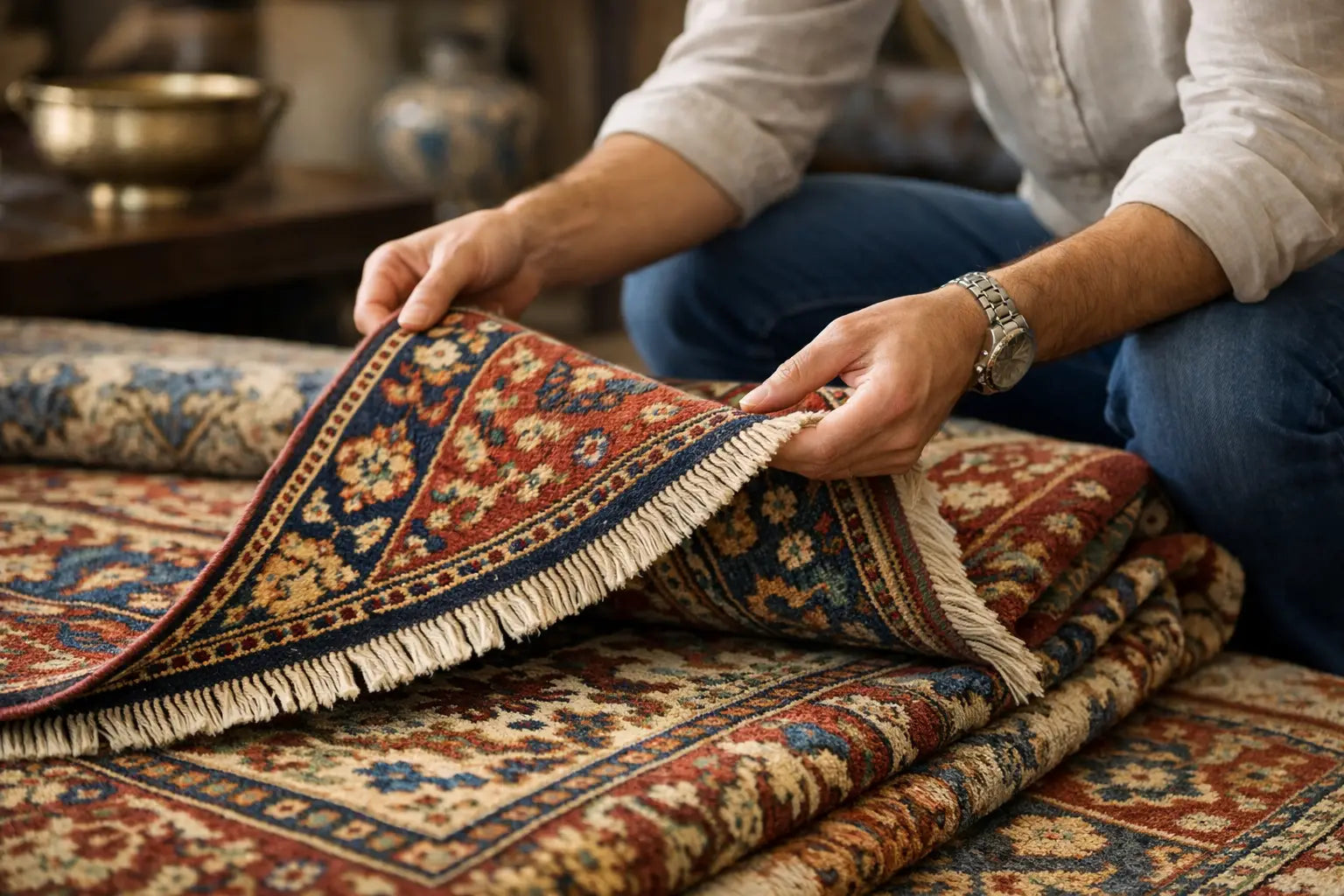
When considering cómo elegir alfombra turca artesanal, craftsmanship is where discernment matters most. Begin with the knotting or weave. A hand-knotted rug will usually show slight variation that gives life to the pattern. Turn it over if possible. The reverse often reveals the clarity of the design and the fineness of the work more honestly than the front.
Density matters, but it is not the only measure of excellence. Very fine knots allow for intricate drawing, yet a slightly more rustic weave can be just as desirable if it reflects the character of the region and the intended use. What you are looking for is integrity - clean finishing, balanced structure, even selvedges, and a handle that feels substantial rather than limp.
Fringes should be seen as part of the construction, not an afterthought. Artificially added fringes can signal lower authenticity. Natural variation in tone or minor asymmetry is not a flaw in artisan work. Often, it is the evidence of the human hand, and that is precisely what gives the piece its distinction.
Ageing, patina and the beauty of nuance
Some buyers are drawn to newly made rugs with crisp colour and stronger definition. Others prefer pieces with gentle patina, softened contrast and that beautifully timeworn poetry that only age or traditional finishing methods can produce. Neither preference is wrong.
What matters is honesty. A rug can be vintage, antique-inspired or newly woven using old techniques, and all three can be compelling. The value lies in transparent provenance and in whether the finish feels authentic rather than artificially distressed. A well-aged rug has depth. A poorly treated one can look tired before it has even entered your home.
Practical considerations for elegant living
Luxury should still be lived with. If the rug is for a family sitting room, look for wool, medium density and colours that welcome everyday life. If it is for a guest bedroom or formal study, you can afford to be more delicate. Entrance areas demand resilience, while dining rooms benefit from lower piles that are easier to maintain.
Maintenance should not be intimidating, but it should be respected. Natural fibres benefit from regular gentle vacuuming and occasional rotation to ensure even wear. Direct sunlight can soften dyes over time, which may be charming in some settings and frustrating in others. Underlay is worth considering, not only for comfort but for stability and longevity.
This is also where trusted sourcing becomes essential. Provenance is not a marketing flourish. It is the difference between a rug with cultural lineage and one that borrows the look without the substance. Retailers who work directly with workshops and makers can usually speak with greater clarity about region, materials and technique. That knowledge protects your investment and deepens your enjoyment of the piece.
Choosing with emotion, not impulse
The finest interiors are rarely built from hurried decisions. A Turkish artisan rug deserves a little patience. Look at it in relation to your architecture, your light and your daily rituals. Ask yourself whether it will still feel compelling when trends move on. The best ones almost always do.
There is also a personal test worth trusting. An exceptional rug has presence even when the room is empty. It does not rely on styling to justify itself. Whether you lean towards a refined Oushak, a more geometric Anatolian weave, or a softly faded vintage piece, choose the one that feels as though it could have been part of your home’s story all along.
At Casa Serena Interiores, this is how we think about artisan objects - not as accessories, but as inheritances in the making. Choose the rug that steadies the room, softens the day and rewards every glance, and you will have chosen well.


