


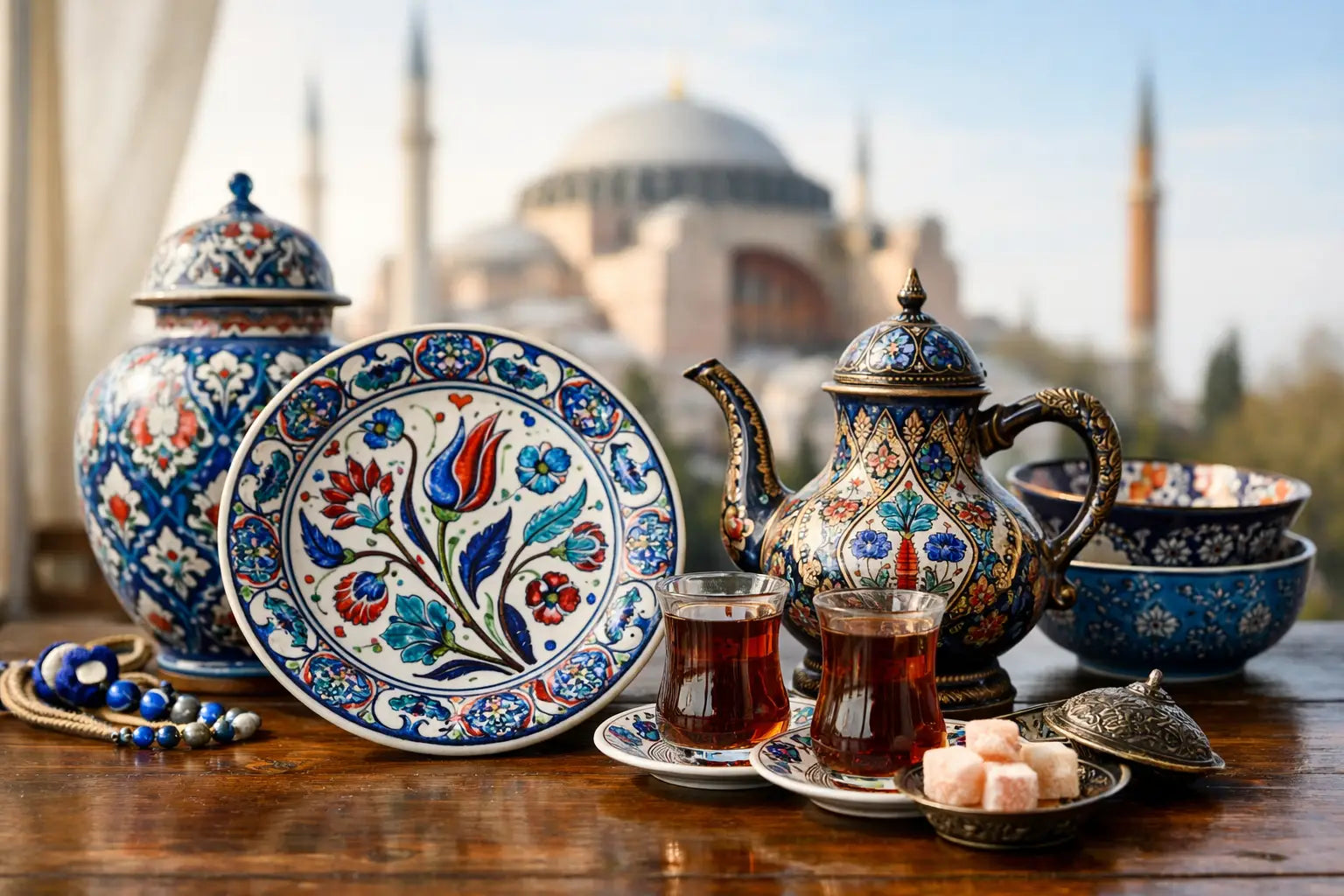
A hand-painted bowl can change the atmosphere of a room faster than a larger purchase ever could. Set on a limestone worktop, layered into an open shelf, or placed at the centre of a table dressed in linen, true Turkish ceramics bring something rarer than decoration - they bring lineage. This guide to authentic Turkish ceramics is for those who want more than a pretty surface. It is for the buyer who cares where a piece was made, whose hand painted it, and whether it will still feel relevant in ten years.
Why authentic Turkish ceramics feel different
There is a visible distinction between ceramic made within a living tradition and ceramic produced to imitate one. Authentic Turkish pieces carry a certain tension between discipline and individuality. The motifs may follow historical language - tulips, carnations, saz leaves, cypress forms, intricate borders in cobalt, emerald, iron red and turquoise - yet no two painted surfaces are ever entirely identical.
That slight irregularity is not a flaw. It is often the very evidence of workmanship. In a market crowded with decorative objects designed to look artisanal, genuine Turkish ceramic still holds the quiet authority of something shaped by practice, not trend. For design-conscious homes, that matters. A room built around enduring materials needs objects with the same inner conviction.
Historically, Turkish ceramics are closely associated with Iznik and later Kütahya, with Ottoman court aesthetics influencing both palette and pattern. Yet authenticity is not only about geography. It also rests on method, material, firing, glaze quality and whether the workshop is part of a real making culture rather than a wholesale supply chain dressed in heritage language.
Guide to authentic Turkish ceramics - what to look for
If you are investing in Turkish ceramic for a refined interior, begin with the surface, but do not stop there. Beauty is easy to imitate. Integrity is harder.
Study the painting, not just the pattern
Many mass-market reproductions borrow familiar Ottoman motifs, but the painting often feels flat or mechanical. On an authentic piece, the brushwork tends to have rhythm. Lines taper. Petals breathe. Repeated forms still show the painter’s hand. Even when a workshop works from established designs, there is usually a softness and movement that printing cannot replicate.
Look closely at blue outlines, red detailing and fine leaf work. If everything appears too uniform, too perfect, or strangely lifeless, it may be transfer-printed or factory-produced at scale. Hand-painted ceramic should feel composed, not sterile.
Pay attention to the glaze
A good glaze gives depth, not merely shine. On quality Turkish ceramic, the surface often has a luminous clarity that allows colour to sit vividly beneath it. Cheap reproductions can appear overly glossy, cloudy, or slightly plastic in effect. This is particularly noticeable in whites and bright turquoise tones.
Small variations in glaze are normal in handmade production. What you want is richness and consistency of finish, not industrial sameness.
Ask about provenance
This is where many buying decisions separate into two very different categories - decorative purchase or collector’s purchase. If a retailer cannot tell you where the piece was made, who produced it, or whether it came from a known ceramic region or workshop tradition, caution is wise.
Authenticity should come with a story precise enough to trust. Anatolia, Iznik, Kütahya, or named artisan workshops are meaningful indicators. Vague phrases such as “inspired by Turkey” or “Ottoman style” are not the same as true provenance.
Expect variation
Handmade ceramic rarely arrives in a set of absolute clones. Slight shifts in brushstroke, shape, spacing or tone are part of its charm and proof of process. For some buyers, especially those used to luxury manufactured tableware, this requires a change in mindset. Authenticity often looks more alive, but also less standardised.
That does not mean accepting poor quality. Chips in the glaze, unstable bases or muddy design are not signs of noble craftsmanship. The art lies in distinguishing handmade nuance from careless finishing.
The difference between Iznik-style and truly traditional work
One of the most useful distinctions in any guide to authentic Turkish ceramics is the difference between “Iznik-style” and historically rooted production. Iznik-style generally refers to pieces that draw from the celebrated Ottoman visual vocabulary associated with the classical Iznik tradition - floral medallions, arabesques, cobalt and turquoise palettes, and the famous sealing-wax red.
This can still be beautiful and entirely worthwhile, particularly when made by skilled contemporary workshops. Not every excellent piece must be an antique-method museum object to deserve a place in your home. But if you are buying with the expectation of strict historical continuity, it is worth asking more detailed questions about clay body, technique, firing and workshop heritage.
For most sophisticated interiors, the right decision depends on intention. If you want decorative depth and authentic handcraft, a well-made Iznik-style serving plate may be perfect. If you are collecting for historical resonance, the threshold for what counts as authentic becomes narrower.
How to choose pieces for a luxury interior
The finest Turkish ceramics do not need to dominate a room. In fact, they are often most persuasive when allowed to punctuate rather than overwhelm.
In a Mediterranean or coastal scheme, a large ceramic platter can soften pale timber, travertine and chalky plaster with welcome colour. In a more tailored interior, a pair of lidded jars or a statement vase can introduce ornament without clutter. Blue-and-white designs feel crisp and architectural; richer palettes with green and red read warmer, more layered and more Ottoman in spirit.
Scale matters. One oversized bowl on a console can feel more considered than six small objects scattered across shelves. Likewise, mixing too many patterns in one sightline can dilute the elegance of each piece. Turkish ceramic has visual confidence. It benefits from restraint around it.
There is also a practical question. Some pieces are made primarily for display, while others function beautifully for serving, storing or styling a table. If you entertain often, invest in forms that move between utility and theatre - platters, shallow bowls, pitchers and small dishes that make the table feel curated rather than staged.
Red flags when buying online
Buying artisan goods online requires a more discerning eye than buying in person. Photography can flatter mediocre work, and heritage language is often overused.
Be wary of listings that offer no close-up imagery, no mention of workshop origin, and no detail on whether the piece is hand-painted or printed. If every item appears identical down to the millimetre, mass production is likely. Extremely low pricing can also be revealing. True handmade ceramic involves labour, skill, firing costs and breakage risk. It cannot be produced honestly at rock-bottom prices.
The most trustworthy retailers tend to present ceramic as cultural work, not anonymous stock. They understand the makers, the regions and the distinctions between inspiration and origin. This is one reason curated specialist houses such as Casa Serena Interiores resonate with buyers who value discernment as much as beauty.
Caring for authentic Turkish ceramics
Once you own a genuine piece, care becomes part of stewardship. Handmade ceramics are made to be lived with, but they deserve a little consideration. Gentle hand washing is usually the safest route, especially for pieces with intricate painting or metallic detailing. Avoid harsh temperature changes, which can stress glaze and body over time.
For display pieces, placement matters more than many people realise. Direct, relentless sun can affect some pigments over long periods, while unstable shelving puts fragile edges at risk. When stacking plates or bowls, a soft linen cloth between them preserves the painted surface.
If a piece acquires faint crazing with age, that is not always a disaster. In some handmade ceramics, it can be part of the natural life of the glaze. Whether it is acceptable depends on the intended use and the character of the piece. For decorative collecting, gentle age can add romance. For frequent serving, durability may take priority.
What makes a piece worth the investment
The answer is rarely just age or rarity. A piece becomes worth buying when craftsmanship, provenance and emotional pull meet. You should feel its presence immediately, but the justification should withstand scrutiny afterwards.
The best Turkish ceramics do more than fill a gap on a shelf. They anchor a table, bring order to a palette, and lend a room that elusive quality of being assembled rather than purchased. They speak of travel, hospitality, artistry and permanence without ever needing to announce themselves.
When you choose carefully, you are not simply buying a decorative object from another culture. You are making space in your home for a tradition that has been shaped across centuries, and allowing that tradition to live in daily view. That is a far more intimate pleasure than trend-led decorating, and one that tends to deepen with time.
If you are drawn to Turkish ceramic, trust that instinct - then refine it. Ask better questions, look more slowly, and choose the pieces that feel not only beautiful, but true.


