


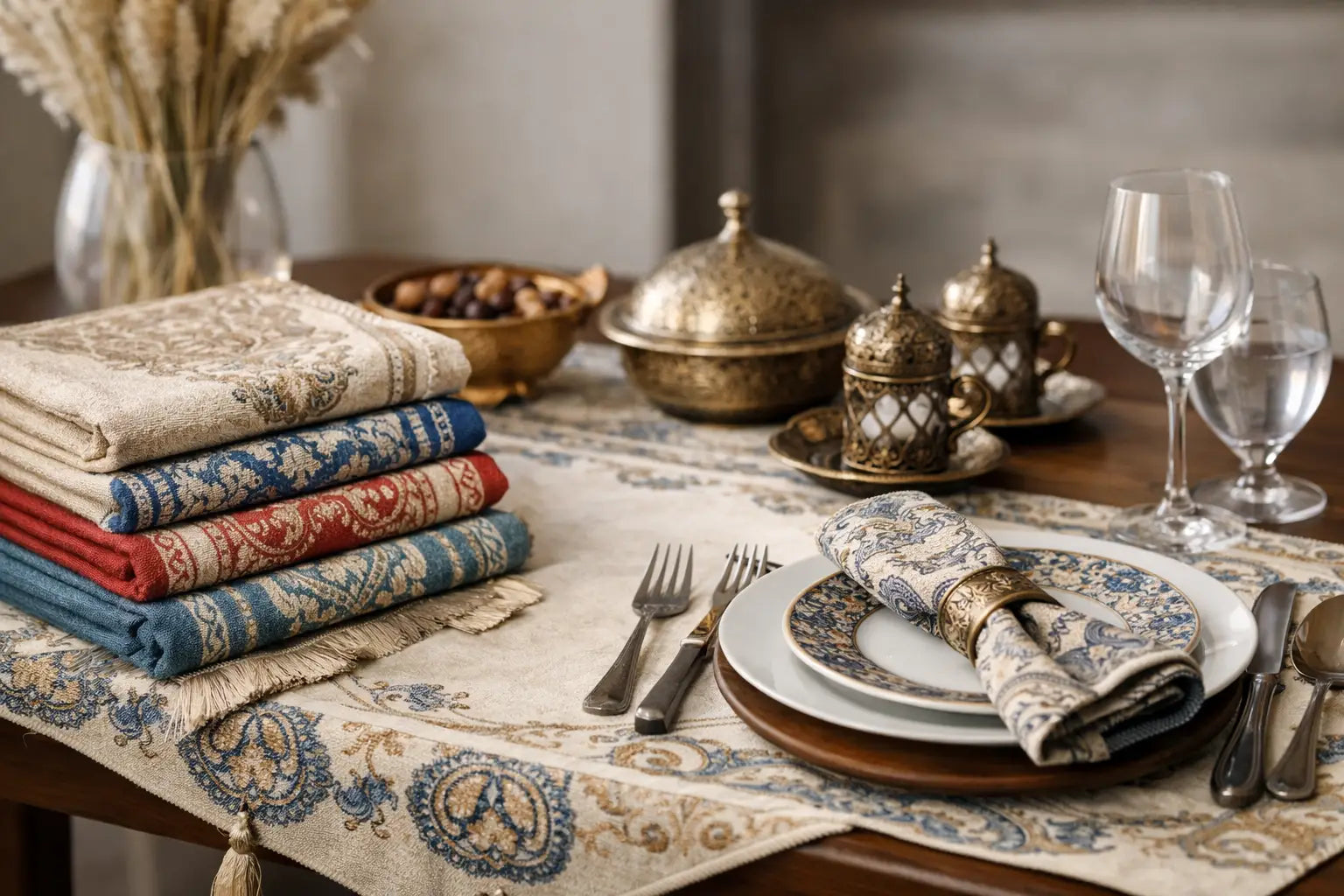
A beautifully laid table tells your guests what kind of home they have entered before a single dish is served. The right Turkish table linen sets do more than protect a surface or frame a meal - they soften light, introduce texture, and create that rare sense of ease that feels both polished and deeply welcoming.
For those who prefer interiors with provenance rather than trend, Turkish table linens hold a particular appeal. They carry the quiet authority of craft traditions shaped over generations, yet they sit effortlessly within a Mediterranean home, a London townhouse, or a coastal retreat. What matters is knowing how to choose well.
Why Turkish table linen sets feel different
Not all table linen is created with the same intention. Mass-produced pieces often aim for visual effect first, with fabrication and finish as an afterthought. By contrast, the finest Turkish linens begin with material, hand, and longevity. The beauty is not merely printed on the surface. It is woven into the cloth itself.
Turkey has a long and respected textile heritage, and that legacy shows in the details discerning buyers notice immediately - the weight of the fabric, the fluidity of the drape, the clarity of the weave, the subtle irregularities that signal human workmanship rather than machine anonymity. A well-made set feels composed without feeling stiff. It invites use rather than caution.
This is also why these pieces suit homes that are carefully curated rather than simply decorated. They have enough character to hold their own, but they do not compete with ceramics, glassware or seasonal flowers. Instead, they anchor the table with quiet confidence.
The fabrics worth looking for
When choosing Turkish table linen sets, fabric should guide nearly every decision. Linen remains the most coveted for good reason. It has an unmistakable texture, a graceful natural crush, and a relaxed elegance that improves with age. For long lunches, summer entertaining, and tables styled to feel effortless rather than formal, linen is usually the most seductive choice.
Cotton, particularly when woven with care, offers a slightly smoother finish and often feels more structured. It can be ideal for family dining rooms, frequent entertaining, or those who want a neater line across the table. Cotton-linen blends sit beautifully in between. They offer much of linen’s character with a little more ease in care and often a gentler price point.
There is, of course, a trade-off. Pure linen tends to crease more easily, and some clients love that softness while others prefer a crisper look. Cotton may feel more practical, but it can lack the depth and movement that make linen so expressive. The right choice depends on how you entertain and how you want the room to feel.
Weave, weight and finish
Beyond fibre content, pay attention to weave and weight. A finer weave reads more formal and refined, particularly for evening dining or layered tablescapes with polished serving pieces. A slightly heavier or more textural weave can feel sun-warmed and grounded, especially in Mediterranean-inspired interiors.
Finishing matters just as much. Hand-finished hems, delicate borders, tonal embroidery and artisanal detailing elevate a set from functional to collectible. These details should feel considered, never fussy. Luxury table linen does not need to announce itself loudly. It is often the restraint that makes it memorable.
Choosing the right set for your table and style
The most beautiful table linen set in the world will disappoint if the scale is wrong. Begin with proportion. A tablecloth should fall generously enough to feel intentional, but not so low that it overwhelms chairs or catches on guests’ knees. For most dining tables, a drop of around 20 to 30 centimetres feels balanced. More formal settings can carry a longer drop, while casual everyday dining tends to suit a shorter one.
If you are choosing placemats and napkins rather than a full tablecloth, consider the visual rhythm of your table. Round woven placemats bring softness to rectangular tables. Structured rectangular placemats can sharpen a more relaxed setting. Napkins should feel substantial in the hand. Thin, limp fabric instantly lowers the mood, no matter how beautiful the pattern may be.
Your interiors should also guide the choice. If your home leans coastal or Mediterranean, washed linen in chalk, sand, olive or sea-glass blue can feel entirely at home. If you favour a more formal European look, white, ecru and stone with refined embroidery or hemstitching will create a quieter elegance. Pattern has its place, especially if inspired by Ottoman, Anatolian or floral motifs, but it needs discernment. Rich pattern works best when the rest of the table is edited.
Colour and mood at the table
Colour in table linen behaves differently from colour elsewhere in the room. It sits directly beneath food, candlelight and conversation, so it influences atmosphere in a very immediate way. Soft neutrals tend to flatter everything. They allow ceramics, copper serveware and seasonal ingredients to take the lead, while still bringing warmth and depth.
That said, deeper tones can be exquisite when used thoughtfully. Terracotta, indigo, saffron and olive all echo the landscapes and craft traditions of the Mediterranean and Anatolia. They work particularly well in autumn and winter, or in homes where the table is meant to feel expressive rather than restrained.
A useful rule is to think in layers rather than statements. If the table linen carries colour, keep crockery and glassware calmer. If your dinnerware is ornate, let the cloth recede slightly. Good styling is rarely about adding more. It is about allowing each piece enough space to be seen.
What separates artisan linen from wholesale lookalikes
The luxury buyer is not only paying for appearance. She is paying for discernment, for traceability, and for the reassurance that what enters her home was made with care. This is where provenance matters.
Authentic artisan-made linens often reveal themselves through subtleties. The stitching is precise but not mechanical. The fabric has life in it. The tones are complex rather than flat. There may be slight variations that remind you a maker’s hand was present from beginning to end. None of this should read as flawed. It should read as real.
Wholesale imitations often chase the same palette and mood but miss the soul entirely. They can look convincing in a product image, yet feel lifeless once laid on the table. This is why curated sourcing matters so much. Retailers who work closely with workshops and makers, rather than anonymous catalogues, tend to offer pieces with far greater integrity. At Casa Serena Living, that sense of origin is part of the pleasure - knowing the object has travelled from a living tradition into your home.
Caring for fine linens properly
The best Turkish linens are made to be used, not stored away for a future that never comes. Proper care helps them age beautifully. Most linen and cotton pieces benefit from a gentle wash at a lower temperature with mild detergent. Harsh chemical treatments and heavy softeners can flatten the natural character of the cloth over time.
Air drying is often kinder than aggressive tumble drying, though a brief tumble on low can soften linen if needed. Some people prefer to iron while the fabric is still slightly damp for a more polished finish. Others embrace linen’s natural creases as part of its charm. Neither approach is wrong. It simply depends on whether you want your table to feel tailored or relaxed.
Stains should be treated promptly, especially from wine, oil or deeply coloured sauces. Fine linens are resilient, but neglect is harder to recover from than use. A tablecloth that is loved and laundered properly will often become more beautiful with the years.
Investing in pieces you will return to
A truly good table linen set earns its place season after season. It appears at summer suppers, birthday lunches, Christmas tables and quiet Sundays when only the family is gathered. This is where value reveals itself. Not in novelty, but in repetition.
If you are building a collection, start with one or two versatile sets in refined neutrals, then add a more expressive piece for festive occasions or warmer months. That approach gives you flexibility without clutter, and ensures every item has a role within your home.
The table is one of the most intimate stages in any interior. It is where hospitality becomes visible. Choose linens that carry history, texture and grace, and your everyday meals begin to feel a little more memorable.


