


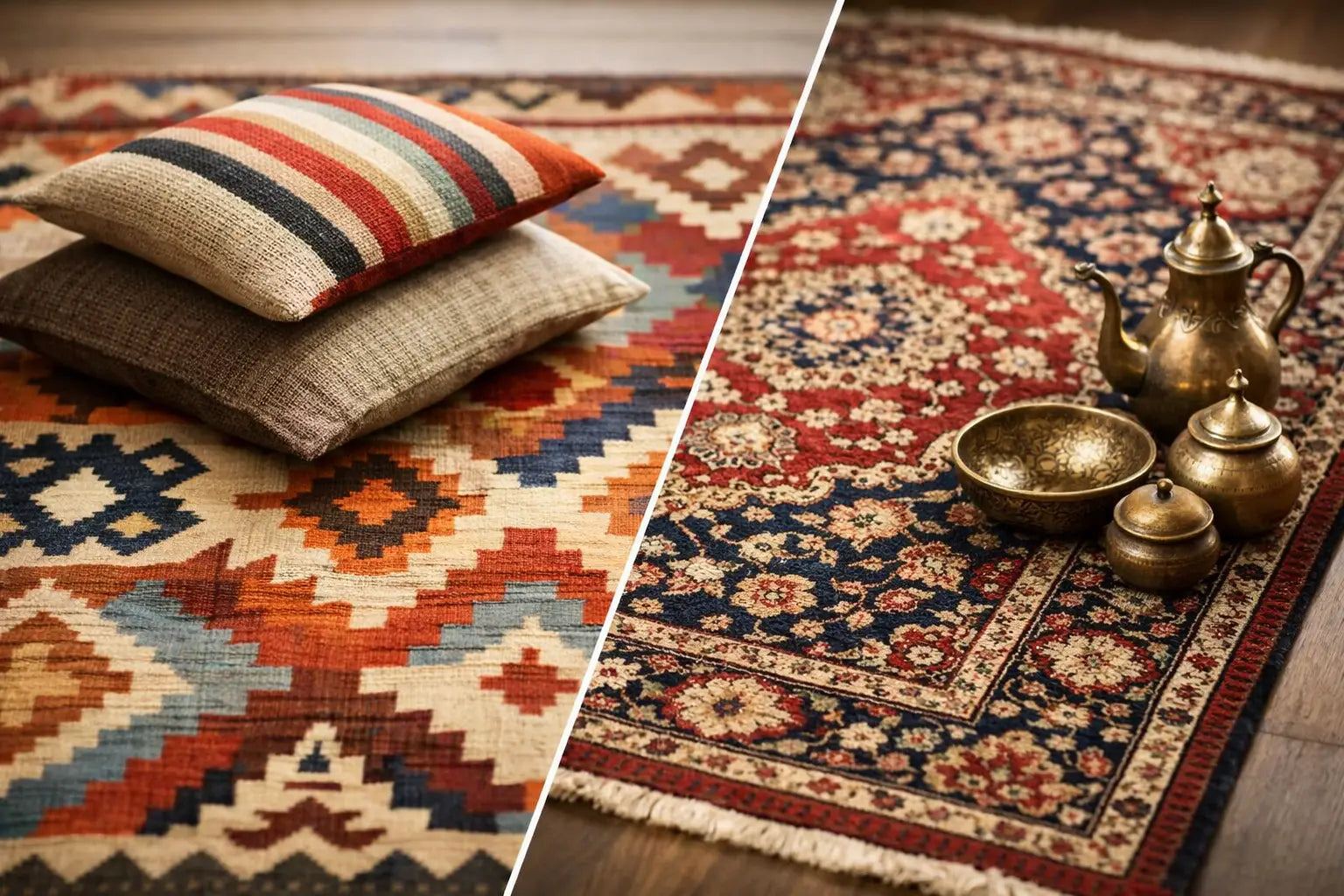
A beautiful rug can change the emotional temperature of a room faster than almost any other object. It softens architecture, anchors furniture, and quietly tells your guests what kind of home this is. When the choice comes down to kilim rug vs Persian rug, the decision is rarely about which is better. It is about which story, texture and presence belongs in your space.
For a design-led home, that distinction matters. A rug is not simply a floor covering. It is a surface of memory, labour and regional character. Kilims and Persian rugs both carry heritage, but they speak in very different visual languages.
Kilim rug vs Persian rug: the essential difference
If you place them side by side, the first difference is immediate. A kilim is flatwoven, so it has no pile. Its beauty comes from structure, geometry and clarity of pattern. A Persian rug is typically pile-woven or knotted, with a richer, denser handle underfoot and often a more intricate visual field.
That single technical difference shapes almost everything else - how the rug feels, how it reflects light, how formal it appears, and where it lives best within the home. One offers crispness and ease. The other offers depth and opulence. Neither is a compromise when chosen well.
How each rug is made
The making of a kilim
A kilim is created through a flatweave technique in which coloured wefts are tightly woven through the warp. Because there is no cut pile, the surface sits smooth and relatively light. This gives kilims their unmistakable character: graphic motifs, rhythmic borders and a certain airy confidence that works beautifully in Mediterranean, coastal and relaxed contemporary interiors.
There is also an honesty to a kilim. The weave is visible. The design is direct. You notice the hand of the maker in the shifts of colour, the slight irregularities, the movement across the textile. In a room that values warmth over perfection, this can be incredibly alluring.
The making of a Persian rug
A Persian rug is usually hand-knotted, often with astonishing precision. Thousands upon thousands of knots create a soft pile and allow for extraordinary detail - florals, medallions, curvilinear motifs and layered tonal transitions that would be impossible in a flatweave. The result is often more formal, more painterly and more visually dense.
That density is part of its seduction. A Persian rug does not simply sit in a room; it establishes one. It carries gravitas, and in the right interior it can feel like a piece of art underfoot.
Texture, comfort and daily life
For many homes, the real question is not aesthetic but practical. How do you want the room to feel when you walk into it barefoot first thing in the morning?
A kilim has a leaner, flatter texture. It is easier to layer, easier to move, and often easier to place beneath dining tables, in hallways or in rooms where doors need clearance. Its lighter profile also suits summer houses, sun-filled spaces and interiors that favour an effortless, collected mood.
A Persian rug tends to feel more plush and enveloping. In bedrooms, formal sitting rooms or reading corners, that softness can be deeply inviting. It absorbs sound more readily and gives a space a sense of hush and permanence. If your aim is atmosphere and comfort, a Persian rug often delivers it with ease.
There are, of course, trade-offs. A kilim may feel less indulgent underfoot, especially in a large sitting room. A Persian rug may require more consideration in high-traffic or spill-prone areas. The right choice depends on how beautifully you want the rug to live, not just how beautifully it looks on day one.
Pattern and visual mood
Why kilims feel lighter
Kilim designs are often geometric, tribal and rhythmic. The motifs repeat with confidence, and the flatweave keeps every line crisp. This makes kilims especially attractive in interiors where you want pattern without heaviness. They bring movement, colour and heritage, yet still leave room for linen upholstery, pale woods, plaster walls and Mediterranean light to breathe.
A kilim can also make a room feel younger and more relaxed. Not casual in a careless sense, but edited, travelled and self-assured. It suggests a home assembled over time.
Why Persian rugs feel richer
Persian rugs often carry a more ornate visual language. Even in restrained palettes, there is usually complexity - botanical motifs, layered borders, subtle abrash, central medallions, symbolic forms. They suit rooms that can hold visual richness: darker woods, antique pieces, sculptural lighting, velvet, marble, brass.
Yet a Persian rug is not only for traditional homes. In a minimal interior, one exceptional Persian piece can create tension in the most beautiful way. It warms clean lines and prevents a room from feeling too studied.
Which works best in different rooms?
This is where the conversation around kilim rug vs Persian rug becomes especially useful.
In a hallway, a kilim is often the more practical and visually nimble choice. Its flat structure handles movement well, and its lighter weight makes it easier to place in narrower spaces. In a dining area, a kilim also has advantages because chairs slide more easily over a low-profile weave.
In a bedroom, many people lean towards a Persian rug for comfort and softness. The same is true in a drawing room or a reception space where the mood is more cocooning and refined. If you want a room to feel intimate in the evening, a Persian rug contributes a sense of depth that a flatweave rarely does in the same way.
For layered interiors, the answer may be both. A kilim in the kitchen or entrance, a Persian rug in the sitting room, and perhaps a smaller vintage textile in the bedroom can create a home that feels collected rather than matched.
Durability, maintenance and ageing
Both kilims and Persian rugs can last beautifully when well made, but they age differently.
A kilim is often admired for its resilience in everyday spaces. Because it is flatwoven, it does not crush in the way pile can. It is practical for homes with frequent movement and for households that prefer a less ceremonial approach to living. That said, kilims can shift underfoot more easily and may need proper underlay to sit well.
A Persian rug, especially a hand-knotted one of good quality, can be astonishingly durable. It is made to endure generations, not seasons. However, pile rugs tend to show wear patterns differently, and care matters. Rotation, thoughtful placement and appropriate cleaning help preserve both colour and structure.
Age can be extraordinarily kind to both forms. A vintage kilim develops softness and quietness. An older Persian rug often gains patina and nuance that new pieces simply cannot imitate. For collectors and design lovers, that ageing is not a flaw. It is the beginning of beauty.
How to choose with discernment
The most elegant interiors are not built by following rules. They are built by noticing what the room asks for.
Choose a kilim if you want graphic clarity, a lighter visual footprint and a more relaxed, architectural feel. It is particularly suited to coastal homes, Mediterranean palettes, informal dining spaces and rooms where natural texture leads the conversation.
Choose a Persian rug if you want softness, intricacy and a stronger sense of grandeur. It excels in spaces that need emotional weight, decorative richness or a focal piece with lasting presence.
And if you are torn, pay attention to the furniture first. Sleek contemporary lines often benefit from the warmth and complexity of a Persian rug. More rustic, textural or sun-washed interiors often glow beside the crisp geometry of a kilim. The room usually tells you, if you listen closely enough.
At Casa Serena Interiores, this is how we think about artisan pieces from Anatolia and beyond - not as interchangeable categories, but as objects with soul, provenance and a very particular role in the home.
A well-chosen rug does more than complete a scheme. It changes how a space is inhabited, how light settles across the floor, how conversation gathers, how memory begins. Whether you are drawn to the refined graphic language of a kilim or the layered romance of a Persian rug, choose the piece that makes the room feel unmistakably yours.


