


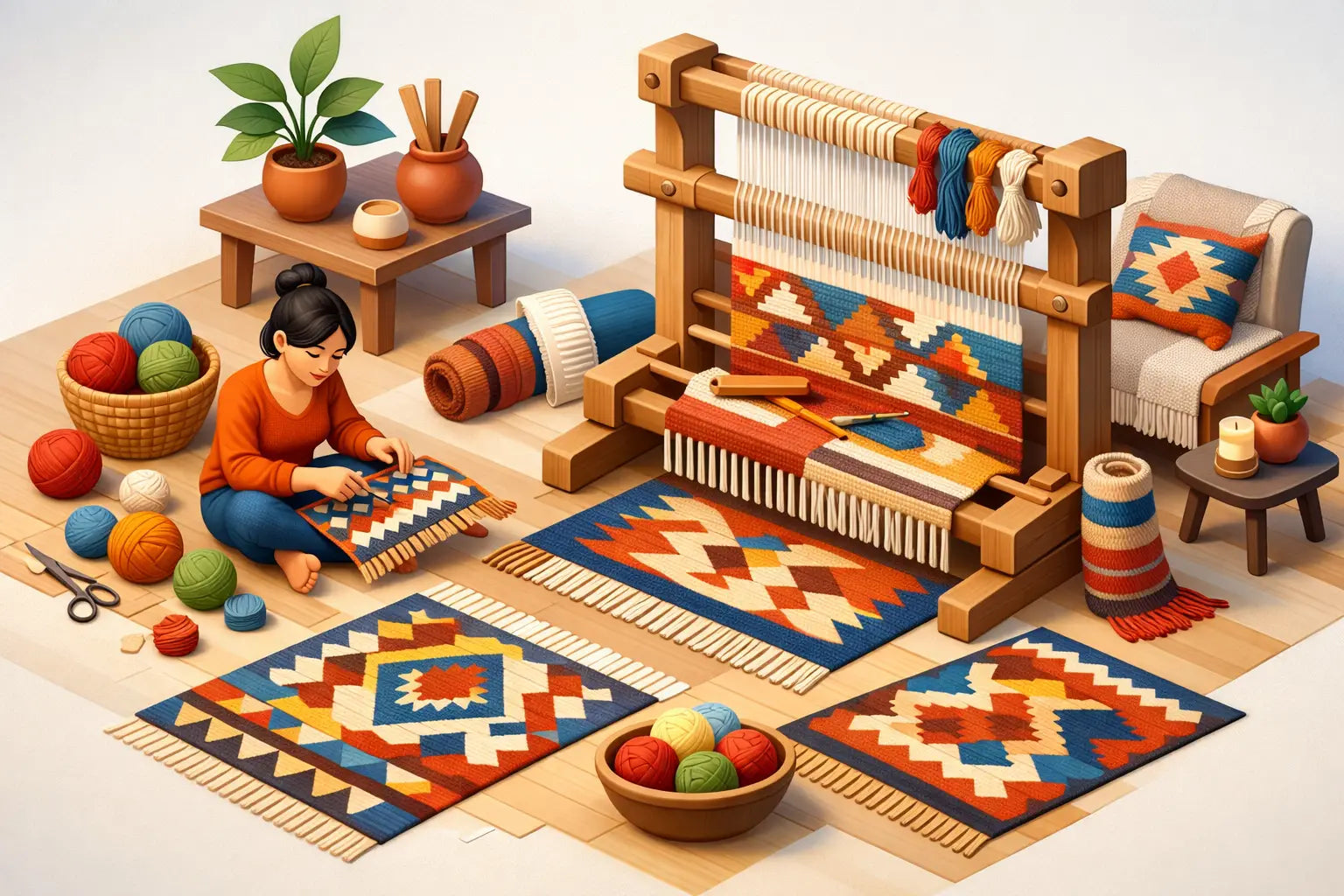
There are pieces that dress a room, and others that completely change its language. Hand-woven kilim rugs belong to the latter category. They don't arrive in a home to fill an empty floor, but to introduce a visual cadence, a textile memory, and a beauty that needs no artifice to assert itself.
At a time when too many interiors look alike, an authentic kilim restores uniqueness. Its geometries, its subtle irregularities, the vibrant dyes, and the precise tension of the weave speak of time, craftsmanship, and a material culture that still resists undifferentiated production. What others call decoration, we call legacy.
Why hand-woven kilim rugs continue to fascinate
A kilim doesn't seduce through excess, but through balance. It is a flat, pile-less piece, woven with a technique that favors sharp patterns and visual lightness. This construction allows it to coexist with contemporary, Mediterranean, refined classic, or even minimalist spaces that need soul without sacrificing calm.
Its appeal also lies in what cannot be entirely replicated in a factory. The artisan's hand leaves small variations that are not defects, but proof of authenticity. Each change of tone, each slightly vibrant chromatic transition, each ancestral motif reinterpreted within the loom turns the rug into a utilitarian work of art. That is the difference between buying a decorative surface and choosing a presence.
Furthermore, hand-woven kilim rugs age with dignity. They do not seek the ephemeral impact of a trend. They integrate, mature, and, over time, acquire an emotional patina that makes them even more valuable in the home.
The value of flat weave and artisanal origin
The kilim tradition has its roots in Anatolia and other regions where textiles have been, for centuries, a way of narrating daily life, territory, and belonging. In many cases, geometric symbols were not purely ornamental. They represented protection, fertility, union, abundance, or a desire for prosperity. This symbolic load adds depth to a piece that, seen from afar, might seem merely beautiful.
Flat weave also has a highly valued virtue in sophisticated interiors: it introduces texture without adding heaviness. Compared to denser or more voluminous rugs, a kilim allows the architecture to breathe. It defines, frames, and provides warmth, but maintains a light visual interpretation. This is especially valuable in bright living rooms, serene bedrooms, or dining rooms where refinement without saturation is sought.
However, it is important to understand the nuance. An artisanal kilim is not the right choice for someone who expects absolute uniformity. Its charm lies precisely in the human imprint. If a industrially perfect piece is desired, the language of the kilim may not be the most appropriate. If character is sought, then yes.
How to choose a hand-woven kilim rug with discernment
Choosing well requires looking beyond color. An excellent piece must dialogue with the home, but also with the rhythm of life of those who inhabit it.
Size determines elegance
A small rug in a large living room usually diminishes the overall effect. One that is too large can stifle the space's breathing room. In the living area, the ideal is for at least the front legs of the sofa and main seats to rest on the rug. In the bedroom, it should extend sufficiently on both sides of the bed so that the piece feels generous, not incidental.
In hallways or entrances, an elongated kilim acts as an immediate style statement. Where the home begins, its story also begins.
Color should accompany, not impose itself meaninglessly
Earthy palettes, muted reds, deep blues, ochres, and ivories are common in traditional Anatolian kilims. The key is to decide whether the rug will be a chromatic anchor or a note of contrast.
In neutral interiors, a kilim with a defined pattern can provide the exact vibration that prevents coldness. In spaces already rich in materials, it is advisable to opt for more serene compositions, where the pattern accompanies without competing. It's not about detracting from its presence, but about intelligently managing it aesthetically.
The density of the pattern changes the character of the room
More geometric and repetitive motifs provide rhythm and structure. More open designs or those with larger color fields create a more relaxed feeling. Neither option is superior to the other. It depends on the desired effect.
If the furniture has clean lines and few ornamental concessions, a kilim with personality can greatly enrich the ensemble. If there are already patterns, decorative ceramics, or very expressive textiles, a more restrained rug is usually more sophisticated.
Where hand-woven kilim rugs shine brightest
There is something particularly noble in seeing a large artisanal piece occupying the center of the living room. Under a wooden coffee table, alongside washed linen, ceramic with character and warm lighting, the kilim introduces a balanced tension between the refined and the lived-in. There's no need to overload the space. Simply let the rug set the scene.
In the bedroom, the effect changes. Here, the kilim provides intimacy. Its flat texture, graphic language, and visual warmth transform the room into a more personal sanctuary. It works very well with upholstered headboards, light woods, calm walls, and natural fiber bedding.
In the dining room, the choice requires a little more attention. Being a flat piece, the kilim allows chairs to be moved with relative ease, a real advantage compared to thicker options. Even so, it is advisable to choose a rug of sufficient size so that the chairs remain on it when pulled away from the table.
In foyers, offices, or reading nooks, its presence has an almost curatorial quality. It seems like a thoughtful decision, not an automatic gesture. And that difference is perceived.
What distinguishes an authentic kilim from an industrial version
Authenticity is not always detected at a single glance, but it does leave clear signs. A hand-woven kilim usually shows small irregularities in the outline or motif. The front and back share a very similar reading of the pattern, precisely because of the nature of the flat weave. Materials also matter: well-worked wool offers body, nuance, and a tactile response rarely achieved with synthetic fibers.
Provenance also matters. When a piece comes from artisan workshops with a real textile tradition, it not only acquires aesthetic value. It gains cultural legitimacy. In a brand like Casa Serena Interiores, this selection is not a response to a fleeting exotic trend, but to a curatorial vision where origin, quality, and beauty must mutually support each other.
However, authenticity comes at a higher price than an industrial reproduction, and it's worth stating that directly. This difference is not only explained by the material, but by the time, skill, and limited scale of production. For certain buyers, it will be a fully justified investment. For others, it will depend on the role they want the piece to play in their home.
How to care for a legacy piece
An artisan rug doesn't demand excessive devotion, but it does require conscious attention. Vacuuming it gently without aggressive brushes helps preserve the fabric's structure. It's advisable to rotate it periodically if it receives direct light or uneven traffic, so that wear is distributed harmoniously.
If a stain appears, it's best to act promptly, delicately, and without saturating the fiber. For valuable pieces, specialized professional cleaning is usually the most sensible option. Not because of fragility, but out of respect for the work it contains.
It's also worth accepting that a living rug changes with the house. It can settle, soften, and show the passage of time. Far from detracting from its value, this reinforces its domestic dimension. A kilim is not made to remain untouchable, but to accompany a beautiful life.
An aesthetic choice, but also a cultural one
Buying authentic craftsmanship has a silent dimension that goes beyond taste. It means favoring crafts that preserve knowledge, protecting more human production rhythms, and choosing objects that are not born of anonymity. In a market saturated with pieces without a story, that decision becomes increasingly significant.
Hand-woven kilim rugs are interesting as much for their beauty as for what they represent. They are a way of incorporating heritage into everyday spaces without falling into nostalgia. They can coexist with contemporary design, modern art, and refined architecture because they don't belong to the past in a rigid way. Their language is ancient, yes, but their presence remains extraordinarily current.
Perhaps that's why they are so moving. Because they don't decorate superficially. They take root. And when a house finds a piece capable of doing that, it stops seeming composed and finally begins to feel like its own.


