


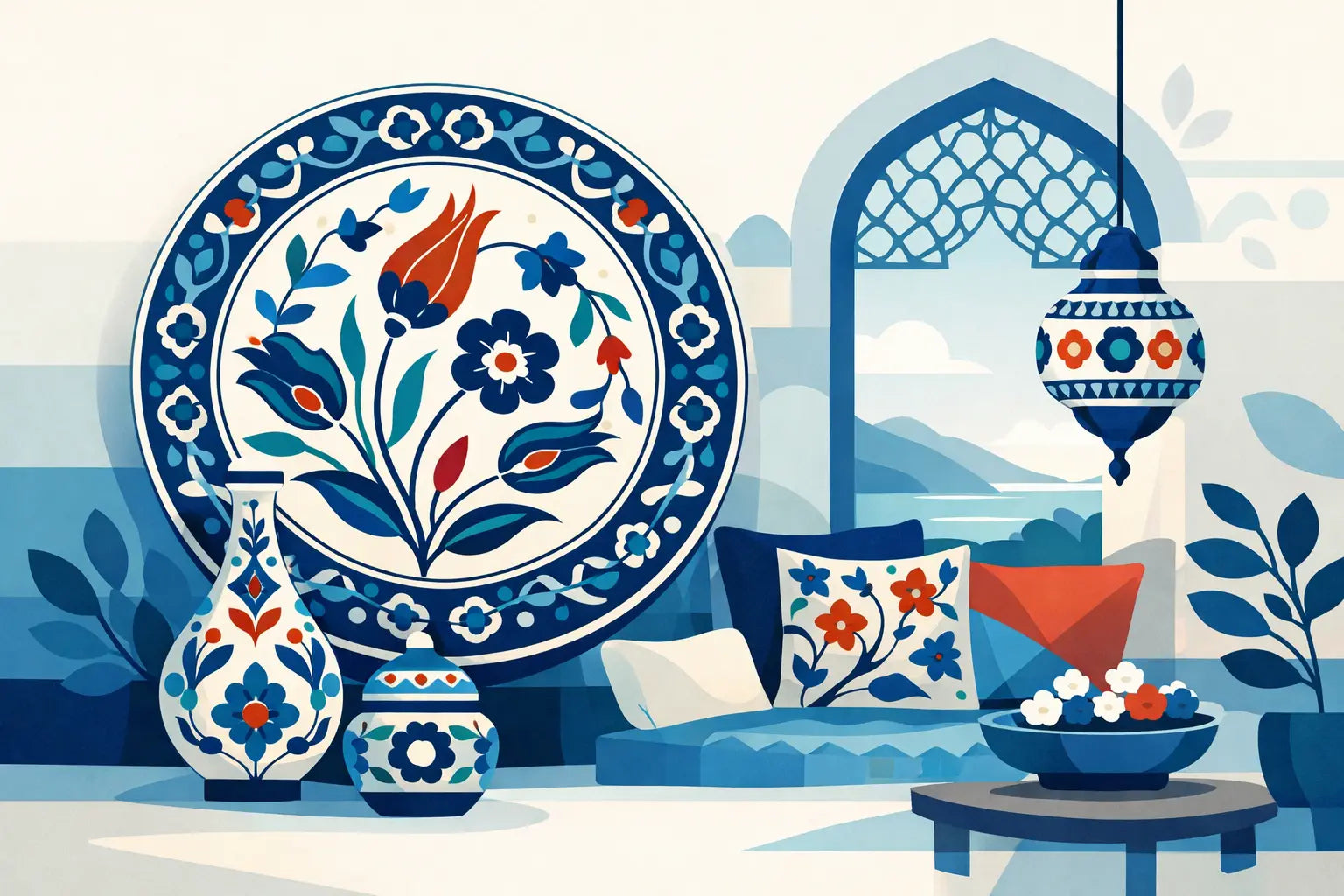
Some pieces fill a shelf, and others change the aesthetic temperature of a room. Handcrafted Iznik ceramics belong to this second category. They don't enter a home as a simple decorative object but as a presence with a lineage: mineral color, disciplined pattern, restrained luster, and a cultural memory that remains alive centuries later.
Those who choose it usually don't just seek beauty. They seek provenance, character, and a feeling increasingly scarce in contemporary interior design: that of living with something that wasn't born to please everyone but to endure. Therein lies its strength.
What makes handcrafted Iznik ceramics unique
The Iznik tradition originated in Anatolia and reached its most refined moment during the Ottoman period when specialized workshops developed an unmistakable visual language. Slender tulips, carnations, hyacinths, saz leaves, and geometric compositions coexist on luminous white or deep blue backgrounds, with a precision that is not cold but intensely ornamental.
The decisive factor, however, is not just the motif. It is the relationship between drawing, pigment, and surface. Good Iznik-inspired ceramics do not seek baroque excess or industrial perfection. Their charm lies in balance. There is rhythm, symmetry, and a manual vibration that reminds us that each piece has passed through expert eyes and hands.
When we talk about craftsmanship, it's important to be precise. Not every piece with Ottoman aesthetics meets the same level of skill. The authentic tradition values composition, the pulse of the stroke, the quality of the glazing, and the chromatic depth. That cobalt blue, that coveted coral red, those greens and turquoises that seem to capture the Mediterranean light are not casual embellishments. They are the result of know-how, repetition, and technical heritage.
Handcrafted Iznik ceramics: more than a decorative trend
Some trends can make a room feel dated in two seasons. Handcrafted Iznik ceramics operate on a different register. They have the rare ability to be historical and current at the same time. In a clean-lined living room, they add visual density. In a bright kitchen, they introduce accent and depth. In a serene bathroom, they break neutrality without being garish.
This explains why they attract those who reject mass-produced decor. Unlike objects made to fit into any home, an Iznik piece demands context and conversation. It has a clear identity. And precisely for that reason, it elevates the space.
There's also an emotional factor that shouldn't be underestimated. The contemporary home has been filled with correct, functional, and forgettable pieces. Craftsmanship, when honest, restores a form of cultural intimacy. It reminds us that luxury is not always about possessing more but about choosing better.
The difference between a handcrafted piece and a decorative piece without origin
At first glance, two wall plates might seem similar. One reproduces an Ottoman pattern with vibrant colors. The other comes from a workshop that works from tradition, with inherited techniques and visual repertoires. The real distance between them is not just in the price. It's in the density of the object.
A piece without a clear origin usually stays on the surface. It works in photography, fulfills an ornamental function, and rarely offers anything more. A well-selected handcrafted piece contains a story, craftsmanship, and a more complex presence. It doesn't need to justify itself because it's perceived. In the stroke, in the weight, in the way it reflects light.
This doesn't mean that every purchase must meet a collection criterion, but it is worth looking with more demanding eyes. If an object is going to occupy a visible place in the home, it's worth asking what it contributes besides color.
Signs of a good selection
The sharpness of the design is important, but it should not be confused with rigidity. In handmade ceramics, a slight variation can be a sign of authenticity. The glaze should look rich, not flat. The colors need depth, especially in blues and turquoises. And the composition should feel proportionate: neither saturated nor empty.
Cultural coherence also matters. Many reinterpretations mix motifs without criteria, creating striking but rootless pieces. A curated selection, on the other hand, preserves the spirit of Iznik without turning it into a caricature.
How to integrate handcrafted Iznik ceramics into a sophisticated home
The usual temptation is to treat these pieces as exotic accents. This is a common mistake. Iznik ceramics do not need to be presented as a rarity or surrounded by orientalist clichés to work. In fact, when integrated naturally into Mediterranean, contemporary, or refined classic interiors, they reveal all their elegance.
On a wall, a single large-format plate can have more impact than an excessive composition. On a dining table, a handcrafted platter dialogues very well with washed linen, fine glass, and noble wood. In the kitchen, utilitarian or display pieces introduce color without breaking a serene atmosphere. And in an entryway, a vase or bowl with a botanical pattern can resolve the space with quiet authority.
Here, criteria are everything. If the interior's base is neutral, the ceramic acts as a focal point. If the space already contains texture, pattern, or color, it's advisable to moderate. The goal is not to fill but to let the piece breathe.
Where it looks best
The living room and dining room are usually the most appreciative settings because they allow the piece to be seen, read, and become a topic of conversation. The kitchen is ideal when seeking everyday beauty, not just representation. The bedroom allows for less quantity, but a well-chosen presence can add a very personal note. Even the bathroom, if designed with honest materials and a clean palette, accepts details from this tradition very well.
What changes is the scale. A small space requires precision. A large one allows for more scenic gestures.
Color, light, and material: why it works so well in a Mediterranean context
There is a silent kinship between the Mediterranean sensibility and the chromatic tradition of Iznik. Luminous whites, mineral blues, watery greens, and earthy reds coexist with a naturalness that refers both to the sea and to the history of cultural routes between East and West.
That's why these pieces don't clash in Mediterranean-inspired interiors. On the contrary, they enrich them. On soft stucco, aged wood, natural fibers, or light stone, Iznik ceramics introduce a counterpoint of design and shine that avoids monotony. They add refinement, but also visual warmth.
However, there is an important nuance. It works best when the other materials are genuine. If the environment is dominated by imitations, poor finishes, or an overly ephemeral aesthetic, the handcrafted piece becomes decontextualized. Beauty with lineage demands a certain honesty around it.
A purchase made with discernment, not in haste
In premium decor, buying well is a form of editing. It's not about accumulating beautiful objects, but about building an atmosphere where each piece has a reason to be. Handcrafted Iznik ceramics deserve that level of attention.
Before choosing, it's worth considering the place it will occupy, the light it will receive, and the dialogue it will establish with the rest of the space. Also, the kind of relationship sought with the object. There are pieces for everyday use and others closer to contemplation. Neither option is inherently better. It depends on the house and the real life of its inhabitant.
At Casa Serena Interiores, we understand that difference. That's why a handcrafted piece is not presented as an interchangeable accessory but as an object with provenance, presence, and a vocation for permanence. What others call decoration, we call legacy.
Choosing Iznik ceramics is, at heart, a statement of taste. It speaks of a perspective that values history without falling into nostalgia, that appreciates ornament when supported by craftsmanship, and that understands the home as a space of lived beauty, not rapid consumption.
Perhaps that is its greatest virtue. It doesn't impose. It doesn't need noise. It simply remains, refining the home over time, until one day it becomes impossible to imagine that corner without it.


