


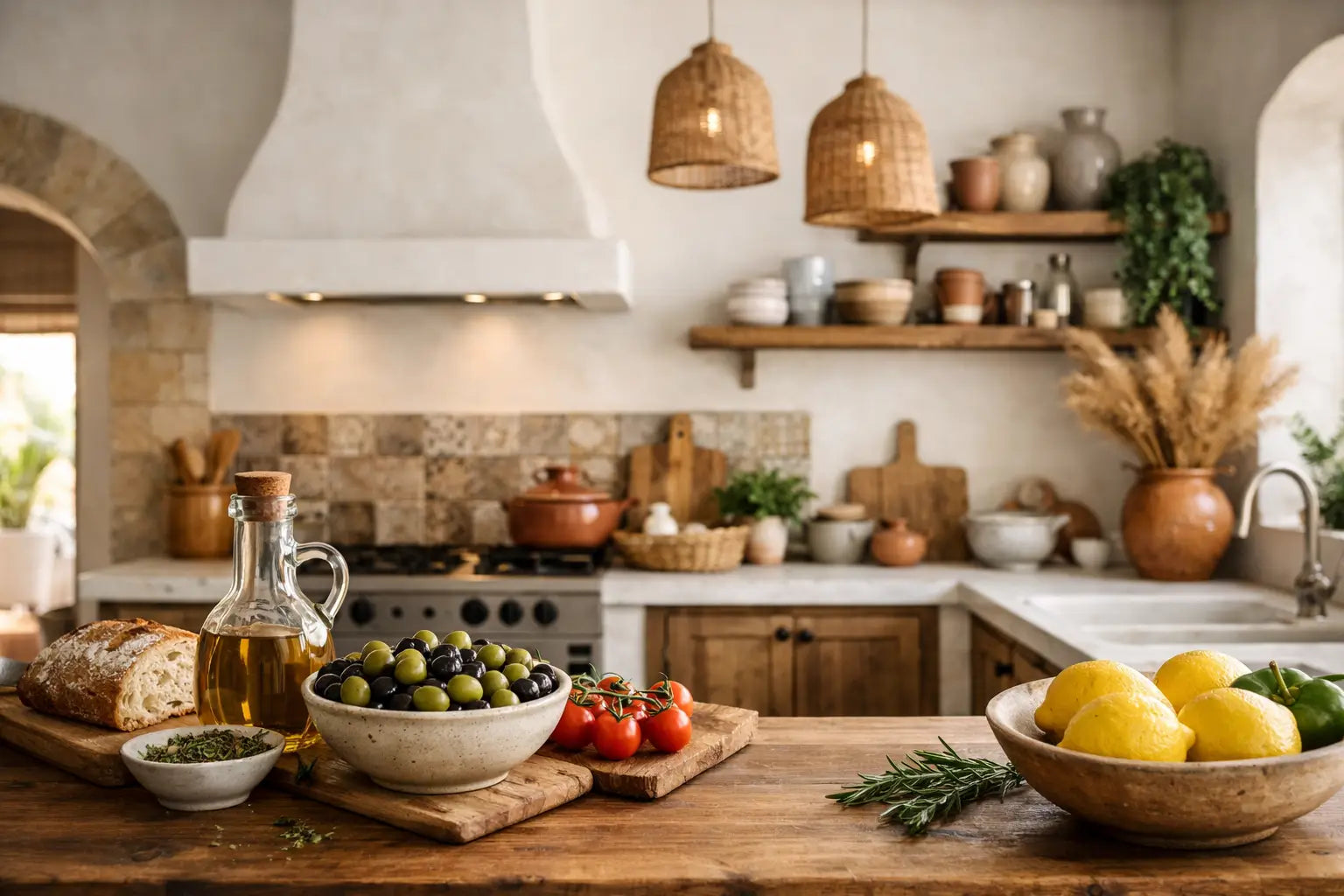
There are kitchens that merely fulfil a function, and there are kitchens that change the way a house is lived in. Mediterranean kitchen decor belongs to the latter category. It does not seek cold perfection nor an impersonal staging. It seeks light, material, memory and that difficult balance between serene beauty and everyday life.
In a well-resolved Mediterranean kitchen, every element seems to have arrived for a reason. The grain of the wood softens the stone. The ceramics bring rhythm and character. Aged metal introduces a discreet gleam. Nothing looks rushed, nothing appears to be chosen at random. That is precisely its charm: a room that feels curated, not simply decorated.
What defines Mediterranean kitchen decor
More than a catalogue of objects, Mediterranean kitchen decor is an atmosphere. It is born of sunlit houses, honest materials and a more unhurried relationship with the home. Rather than chasing a concrete trend, it favours surfaces that age with dignity and pieces that retain the mark of the hand that made them.
The palette usually starts from warm whites, stone tones, sand, terracotta, olive green and deep blues that recall the sea and traditional ceramics. However, the secret is not to copy a literal colour range, but to create contrast between freshness and warmth. A white that is too pure can feel sterile. An overload of earth and ochre can make the space lose air. Proportion matters.
Texture matters too. A Mediterranean kitchen needs surfaces that converse with one another: lime, clay, linen, marble, oiled wood, copper, glazed ceramics. When everything is smooth and perfect, the result moves away from the relaxed luxury that defines the style. When everything is rustic, it can become heavy. The key is to mix refinement and naturalness.
Light as the primary material
Before thinking about tableware, textiles or accessories, it is worth looking at the light. In this style, light is not a technical detail. It is the element that reveals the beauty of every material. A south-facing kitchen can accommodate cooler tones and more pronounced stone. A kitchen with little natural clarity will benefit from warm whites, soft marbles, warm metals and textiles that reflect light gently.
Artificial lighting should accompany that sensation. It is advisable to avoid lights that are too white or harsh, because they harden the atmosphere and erase subtleties. Lamps with a sculptural presence, especially in materials such as aged brass, handcrafted glass or ceramics, work better when they emit a warm, enveloping light. A Mediterranean kitchen does not need to look like a laboratory. It should invite you to linger.
Noble materials that sustain the style
If there is one decision that determines the final outcome, it is the choice of materials. Wood, especially in natural or slightly aged finishes, provides rootedness and calm. It can be introduced in fronts, stools, open shelving or side tables. The less glossy varnish, the better.
Stone and marble elevate the whole, but there are nuances here too. A highly polished, visually cold marble can push the space towards a more urban language than Mediterranean. By contrast, a stone with subtle movement, a creamy marble worktop or a splashback with organic veining bring sophistication without losing warmth.
Ceramics deserve their own place. In a truly considered scheme, they do not appear only as cladding, but as cultural accents. Decorative plates, bowls, glazed dishes and hand-painted pieces introduce identity. Iznik-inspired ceramics, for example, add a particularly rich historical and chromatic dimension when combined with neutral bases.
Copper and patinated metals are also natural allies. They provide reflection, depth and a sense of permanence that overly industrial steel does not always achieve. That said, they should be used with judgement. An excess of metal can harden the room; a few well-chosen gestures are far more distinguished.
Mediterranean colours without falling into cliché
There is a simplified version of this style that reduces everything to blue and white. It can work in a holiday home, but in a main residence it often falls short. The most elegant Mediterranean kitchen decor works with more complex layers of colour.
Base tones should be soft and mineral: limestone, ivory, oatmeal, damp sand, bone. On these you can introduce notes of cobalt blue, laurel green, oxide or terracotta. The trick is that the colour should not shout. It should appear as it does in Mediterranean landscapes: integrated, natural, never forced.
If the kitchen already has dark cupboards or distinctive flooring, it may be wise to use colour only in objects and textiles. If the base is very neutral, you can be more generous with ceramics, lamps or decorative pieces. There is no single formula. It depends on the size of the space, the light and the degree of presence you want each material to have.
How to decorate without losing functionality
A beautiful kitchen that does not work eventually tires you. This style demands visual order, but not rigidity. Open shelves, for example, can be lovely to show artisanal ceramics and blown glass, but only if they are edited. When they are filled with unrelated pieces, the effect dissipates.
The same applies to worktop accessories. A marble mortar, a solid wood chopping board, a handsome oil cruet or a set of ceramic jars can lift the space. Twelve objects competing with one another create noise. In the most refined Mediterranean kitchens there is a clear idea of selection. You see what is necessary and what is beautiful, not everything at once.
Textiles also help to humanise the room. Washed linen tea towels, tablecloths that fall naturally, cushions on a banquette or a light curtain beside a window soften the architecture. It is advisable to avoid fabrics that are too stiff or prints that are overly literal. Elegance here lies in the material, in the feel and in discretion.
Handmade pieces that give depth
What differentiates a well-designed kitchen from a truly memorable one is often the presence of pieces with provenance and character. A hand-thrown bowl, a platter painted by artisans, a hammered copper jug or a carved marble accessory have visual and emotional weight that anonymous objects do not reach.
That is why handmade pieces work so well within this aesthetic. They introduce small irregularities, layers of history and a sense of a lived home with taste. In a Mediterranean kitchen, an object does not simply fill a space. It contributes a story.
For a higher-end result, it is worth mixing ornamental pieces with items for everyday use. The kitchen should not look like a display case. The best spaces show beauty in the quotidian: a tray that is used, a serving dish that passes to the table, a container that holds sea salt or lemons. It is at that crossroads between function and art that the style becomes true.
Mediterranean kitchen decor in a contemporary key
Those who prefer cleaner interiors do not have to renounce this language. Mediterranean kitchen decor can be translated in a contemporary way if lines are simplified and the right materials are retained. Stone-toned, flat-fronted units, a light worktop with organic veining, warm lighting and a few well-chosen handmade pieces are enough to suggest the style without theatricality.
In this approach, less can indeed be more, but only if that less is well chosen. A very minimalist space needs high-quality materials, because there are fewer elements to sustain the atmosphere. Poor ceramics or metals without presence become noticeable immediately. Contemporary Mediterranean style demands restraint, but it also demands discernment.
For those who want a richer, more sensual version, you can introduce greater decorative depth with exposed tableware, embroidered textiles, aged wood and ceramic accents of Turkish or Anatolian origin. Firms such as Casa Serena Interiores understand that balance well between artisanal heritage and coastal elegance, where each piece adds sophistication without losing soul.
Common mistakes when bringing this style home
The most common mistake is confusing Mediterranean with thematic. Fishing nets, seaside signs and an excess of navy blue tend to impoverish an idea that, at its best, is much more cultured and nuanced. Another frequent error is buying everything at once. Kitchens with true personality are usually built in layers, with time and a considered eye.
It is also wise to be wary of finishes that are too perfect. When everything looks newly factory-made, you lose the sense of inheritance and repose. A Mediterranean kitchen appreciates living materials, soft patinas and objects that are not afraid to show their real texture.
If the space is small, the temptation can be to overload it with details to “add style”. It usually works better to choose two or three strong gestures — a beautiful lamp, ceramics with presence, a noble textile — and let them breathe.
The most attractive Mediterranean kitchen does not try to impress at first glance. It seduces in another way. Through the light on the stone, the deep blue of a handmade dish, the copper that reflects a slow afternoon. If materials are well chosen and decoration is intentional, the result not only beautifies the house: it makes it more intimate, more serene and more lived-in.


