


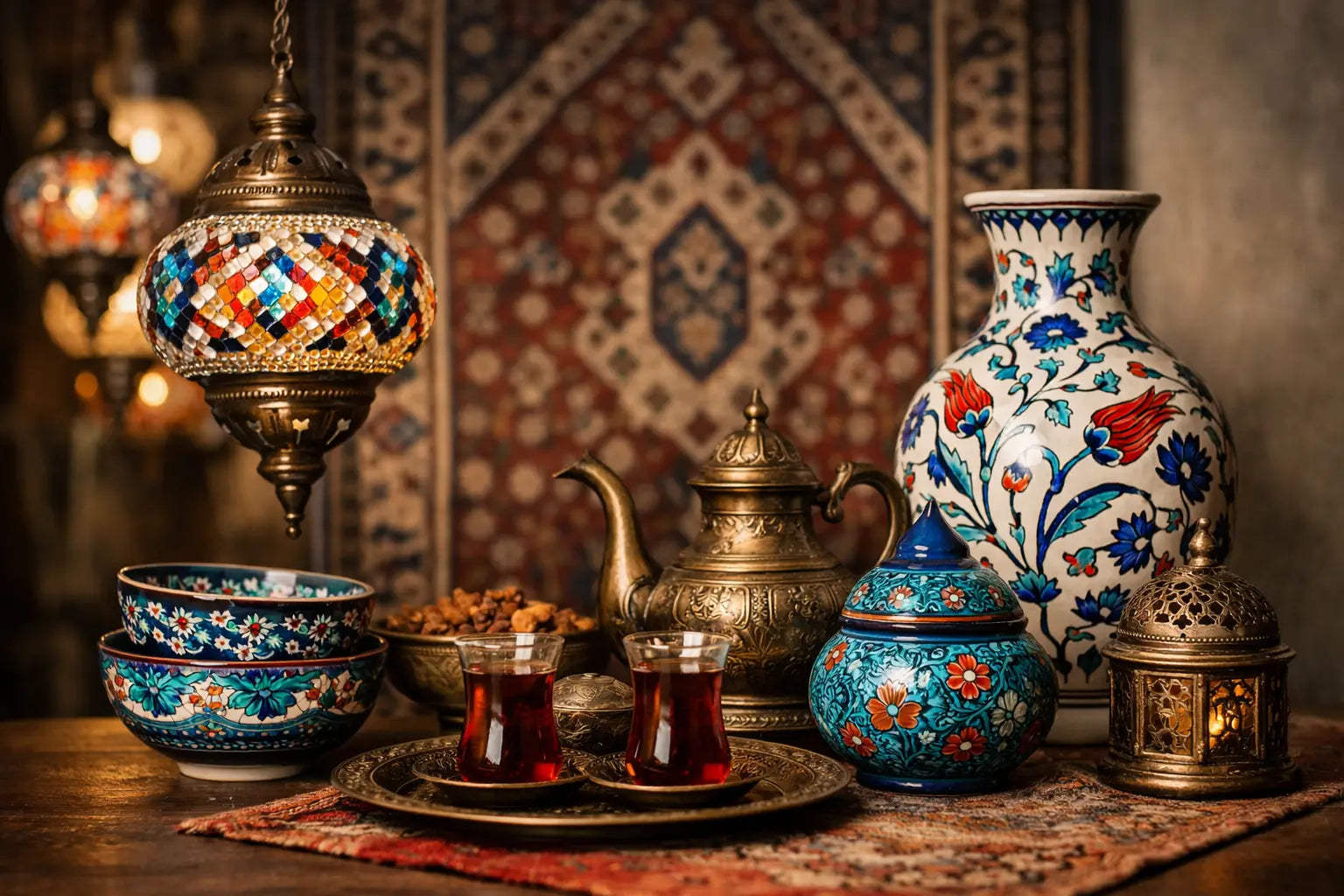
A hand-knotted rug with a slightly irregular border. A ceramic plate whose brushwork is not perfectly repeated. A hammered copper tray that catches light differently at every angle. These are the details that separate true craftsmanship from decorative imitation, and they sit at the heart of any guide to sourcing authentic Turkish decor.
For discerning interiors, authenticity is not a charming extra. It is the difference between a home that feels collected and one that feels merely filled. Turkish decor carries centuries of regional skill, material knowledge and visual language. But as interest in Mediterranean and Ottoman-inspired interiors has grown, so has the market for pieces that borrow the look without carrying the legacy. Knowing what to look for changes everything.
Why authenticity matters in Turkish decor
Authentic Turkish decor has presence because it is shaped by place. A rug from Anatolia is not simply a floor covering in warm reds and faded indigo. It reflects a weaving tradition, a local dye history, a pattern language passed through families and workshops. The same is true of Iznik-style ceramics, peshtemal towels, carved marble and hand-beaten copper.
That heritage affects more than sentiment. It affects quality, longevity and character. Handmade objects often carry small variations in glaze, weave or finish, and those nuances are not flaws. They are evidence of the human hand. Mass-produced alternatives tend to flatten that richness into something visually tidy but emotionally thin.
For buyers creating homes with depth, provenance becomes part of the design brief. You are not only choosing an object. You are choosing what kind of story your rooms will tell.
A guide to sourcing authentic Turkish decor with confidence
The first question is not whether a piece looks Turkish. It is where it comes from, who made it and how much of its making can be traced with honesty. A reputable source should be able to tell you more than a broad aesthetic category. They should know the workshop, the region, the materials and, ideally, something of the making process itself.
This is especially important online, where atmosphere can be manufactured more easily than authenticity. Beautiful photography is valuable, but it is not proof. If a seller cannot explain whether a rug is hand-knotted or hand-tufted, whether a ceramic piece is hand-painted or transfer-printed, or whether a copper tray is genuinely hammered by artisans rather than machine-stamped, proceed carefully.
Good sourcing begins with specificity. Turkey is not one single decorative tradition. Anatolian weaving differs from Aegean textile production. Iznik ceramic traditions carry distinct motifs and histories. Trabzon craft heritage has its own sensibility. Sellers who speak vaguely about “Turkish style” without regional context are often merchandising an aesthetic rather than curating authentic work.
What to look for by category
Rugs are often the first investment piece, and rightly so. A genuine Turkish rug usually reveals itself through material, construction and ageing. Wool should feel substantial rather than synthetic and flat. Hand-knotted rugs show variation in the reverse, where the pattern is visible but not mechanically perfect. Natural dyes tend to age with softness and depth, rather than the abrupt brightness of chemical overprocessing. If a rug appears too uniform, too flawless or suspiciously inexpensive for its size and complexity, that is worth questioning.
Ceramics require a similarly trained eye. Hand-painted Iznik-style plates, bowls and tiles often show tiny differences in brushstroke and glaze pooling. Colours should feel layered and mineral-rich, especially in cobalt, turquoise, soft green and the distinctive iron red associated with Ottoman ceramic traditions. Printed imitations can look crisp, but they often lack depth and the slight movement that gives handmade ceramic work its life.
Copper serveware is another category where shortcuts are common. True artisan copper has weight, warmth and a finish that improves with age. Hand-hammering leaves subtle texture. Interiors may be lined depending on use, and sellers should be transparent about care requirements. Decorative-only copper has its place, but if you are buying for serving or daily ritual, details matter.
Textiles reward closer attention too. Peshtemals and robes made from quality cotton or linen-cotton blends should soften beautifully over time. The weave should feel breathable and absorbent, not overly dense or artificially silky. Fringing should appear properly finished rather than glued or hastily attached. In luxury interiors, these pieces work because they combine utility with understated elegance.
The signs of a trustworthy source
One of the clearest signs of credibility is restraint. A trustworthy curator does not need to claim that every item is ancient, rare or one of a kind. Instead, they describe pieces with care. They distinguish between vintage and newly made, between artisan-crafted and workshop-produced, between heirloom investment and everyday decorative accent.
Transparency around materials is equally telling. You should know if a cushion is silk velvet or a polyester blend, if a marble object is solid or composite, if a ceramic vase is hand-thrown or mould-made. Luxury buyers are rarely disappointed by truth. They are disappointed by vagueness.
Photography can also reveal integrity when it shows detail rather than only mood. Close views of weave, glaze, stitching and finish suggest confidence in the object itself. So does evidence of direct relationships with makers and workshops. Casa Serena Interiores, for example, places value on artisan provenance because that relationship preserves both quality and cultural truth.
There is also the question of edit. An authentic source usually feels curated, not endless. When a retailer offers hundreds of supposedly handmade pieces in identical palettes and formats, caution is sensible. Real craft has variation. It has rhythm, not repetition.
Price, provenance and the myth of the bargain
Many buyers want authenticity at an accessible price, and that is understandable. But Turkish artisan decor sits within a chain of labour, material and transport that deserves respect. Hand-knotting a rug takes time. Hand-painting ceramics requires training. Quarrying and shaping marble, weaving cotton, hammering copper - these processes do not produce bargain-bin objects.
That does not mean the highest price always guarantees the best piece. Some retailers inflate margins through branding alone, while others offer fair value through direct sourcing. The key is to ask what the price includes. Are you paying for natural materials, hand labour, regional expertise and careful curation? Or only for styling and marketing?
A lower price point may be perfectly reasonable for newer workshop pieces, simpler patterns or smaller decorative objects. But if a seller offers a large “handmade Turkish rug” for less than the cost of a standard machine-made wool rug, scepticism is not cynicism. It is discernment.
How authentic Turkish decor works in a refined home
Sourcing well is only half the pleasure. The other half is knowing how these pieces live in a room. Authentic Turkish decor is most compelling when it is allowed to breathe. A single vintage-style rug can anchor a pared-back sitting room more effectively than several trend-led accessories. A cluster of hand-painted ceramics can transform a plain wall or dining table when the palette is restrained elsewhere.
There is a temptation to over-theme globally inspired interiors. Resist it. The beauty of Turkish craftsmanship lies in its ability to bring soul without excess. Copper, linen, marble, ceramic and wool all converse beautifully with Mediterranean whites, limed wood, natural stone and coastal light. The result should feel layered and intimate, not theatrical.
This is where sourcing with discernment becomes a design advantage. When each object has material richness and provenance, you need fewer pieces. Rooms become quieter, yet more memorable.
Common mistakes buyers make
One common mistake is shopping purely by motif. Evil eye symbols, tulip patterns and Ottoman florals have their place, but authenticity does not begin and end with recognisable iconography. Some of the most beautiful Turkish pieces are subtle in pattern and extraordinary in texture.
Another is confusing imperfection with damage. Handmade objects will rarely mimic factory precision. Slight asymmetry, tonal shifts and evidence of hand-finishing often signal value, not defect. Of course, condition still matters, especially with vintage rugs or older ceramics. The point is to distinguish character from compromise.
A final mistake is buying without considering the seller’s point of view. Good curation reflects taste as much as sourcing. The most compelling collections are assembled by people who understand both craftsmanship and interiors, who know how a woven towel sits against travertine, or how a deep cobalt bowl changes a summer table.
When you source authentic Turkish decor with care, you are not chasing an exoticised look. You are choosing objects made with patience, memory and regional intelligence - objects that hold their own long after trends move on. Buy the piece that still feels beautiful when the styling is stripped away, and your home will thank you for years.


