


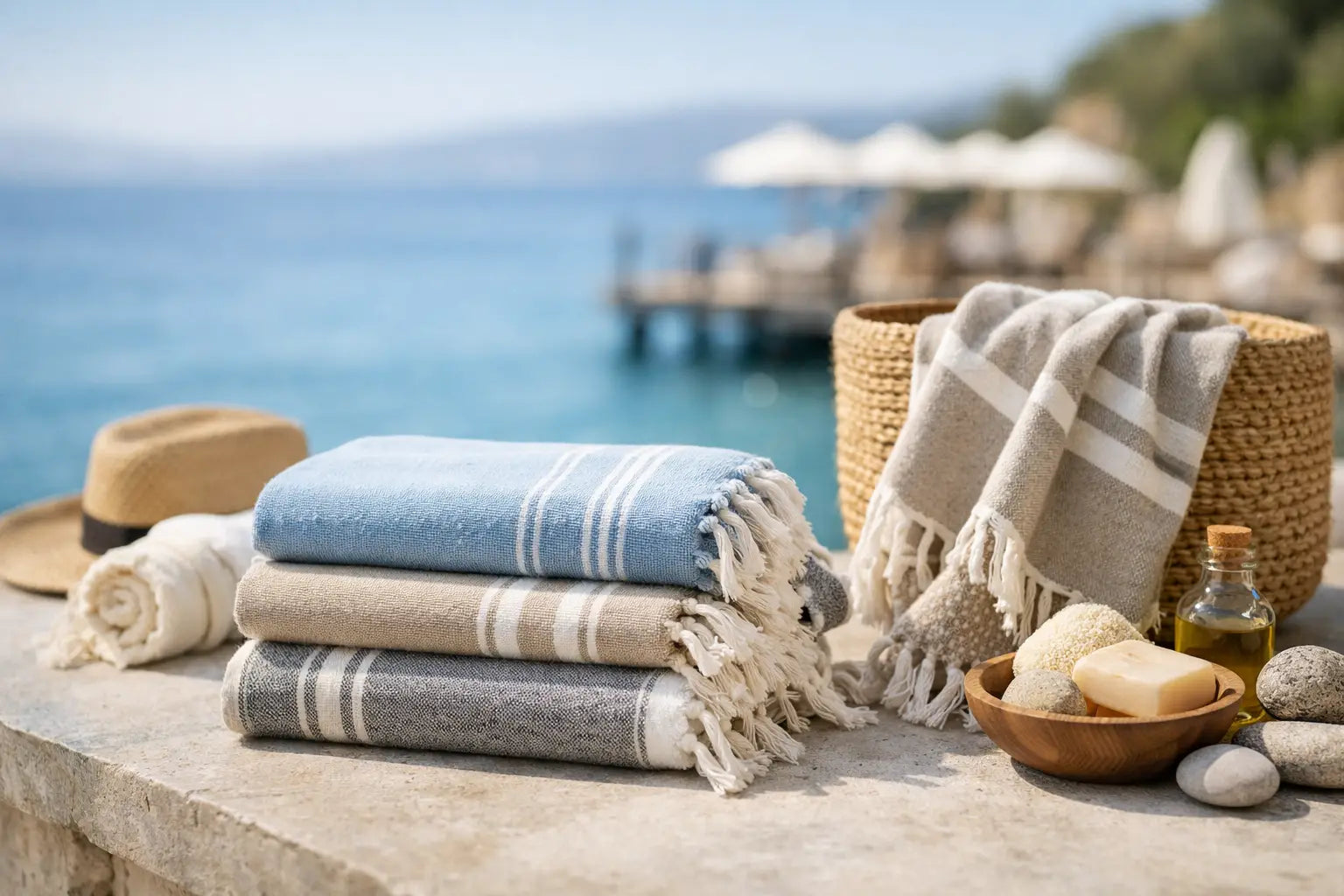
There are textiles that fulfil a function, and there are textiles that change the atmosphere of a home. Understanding what a Turkish peshtemal is places it in that second category: a lightweight piece, woven in cotton and tradition, capable of bringing serene beauty to the bathroom, to the pool, to the holiday suitcase and, above all, to the everyday ritual of self-care.
Far from the voluminous, anonymous towel, the peshtemal has a more subtle presence. It folds easily, dries quickly and ages with a particular grace. In a well-thought-out home, where every object has intent, its appeal lies not only in practicality but in the story woven into its threads.
What is a Turkish peshtemal
A Turkish peshtemal is a flat-weave towel, traditionally woven in cotton, originating from the culture of the Ottoman hammam. At first glance it may seem simple: a smooth or slightly textured surface, delicate stripes, fringes at the ends. However, that simplicity is precisely part of its refinement.
For centuries the peshtemal was used in Turkish baths for a very specific reason. It was comfortable to wrap around the body, absorbent without being heavy and easy to dry between uses. That combination remains its great virtue today. It is not an object reinterpreted for the contemporary market, but a historical piece that still makes sense in modern life.
In the best examples, the weave reveals the loom’s work and the sensibility of the workshop. We are not talking about any towel with an exotic aesthetic, but a textile tradition with its own identity. That nuance matters, especially for those who value authenticity above superficial decoration.
The origin of the peshtemal and its link to the hammam
To understand its value, it is worth looking at its cultural context. The hammam was not only a place of hygiene, but a social, ceremonial and sensory space. Tempered stone, steam, water, olive soap, measured conversations. Within that universe, the peshtemal accompanied the body with lightness and dignity.
Its design responded to a real need. It had to cover without overwhelming, absorb without becoming sodden and dry quickly so it could be used again. That balance between beauty and utility is one of the clearest signs of a well-born object. It was not created for a fleeting trend, but for a way of life.
Over time the peshtemal left the hammam and found a natural place in homes, on coastlines and in travelling. Today it appears in elegant bathrooms, boutique spas, summer houses and well-curated suitcases. The interesting thing is that it has not lost its essence as it changed setting.
What sets it apart from a conventional towel
Comparison with a classic terry towel is inevitable, and also useful. A conventional towel offers an immediate sense of density, something many people associate with luxury. The peshtemal proposes another idea of luxury: less volume, more material intelligence.
Its flat weave takes up much less space in a wardrobe or a bag. This makes it especially attractive in bathrooms where a pared-back aesthetic is sought or in second homes where every detail must be as beautiful as it is functional. It also tends to dry more quickly, an obvious advantage in humid climates or for frequent use by pool and sea.
That said, it is not always a matter of absolute replacement. Some prefer the cuddly embrace of a thick towel in mid-winter. And some reserve the peshtemal for summer, travelling or bathrooms with a more Mediterranean sensibility. As with all good objects, its value depends on context and personal taste.
Materials, weave and feel
Most quality peshtemals are made from cotton. Turkish cotton, in particular, is prized for its long fibres, which allow a soft touch, good absorbency and greater durability with proper use. Some models incorporate linen to add even more lightness and a rawer, more sophisticated texture.
An important detail is that the peshtemal usually improves after the first washes. At first it may feel smoother or firmer than expected. Afterwards, the weave opens up, gains flexibility and becomes more pleasant against the skin. It is one of those pieces that are not quickly consumed but reveal themselves little by little.
Hand-knotted fringes, discreet stripes and mineral or marine palettes are not minor decorations. They are part of a visual language that fits particularly well in serene, coastal and timeless interiors. When well made, a peshtemal does not shout. It whispers.
Why the Turkish peshtemal remains so desired
Part of its appeal lies in how it responds to contemporary life without betraying its origin. It is practical, yes, but also effortlessly photogenic, elegant without stiffness and versatile without seeming purely utilitarian. In an era saturated with objects designed to last little, the peshtemal retains an almost rare quality: the appearance of honesty.
There is also a clear aesthetic component. In a bathroom, a stack of thick towels can look visually heavy. A set of peshtemals, by contrast, introduces air, texture and a sense of calm. It works especially well in spaces where stone, bleached wood, marble or artisanal ceramics already set a refined tone.
It is no coincidence that boutique hospitality buyers and lovers of curated interiors increasingly choose it. A well-selected peshtemal says something about the home and about its inhabitant: that they appreciate heritage, lightness and objects with provenance.
How to use a peshtemal at home
Although many people know it as a bath or beach towel, its use can go much further. In the bathroom it works as a body towel, a guest hand towel or a decorative piece draped over a wooden ladder or a brass hook. In summer, it accompanies a day by the sea or an afternoon in the garden perfectly.
It can also be used as a lightweight throw over a sun lounger, as an improvised shawl on cool evenings or even as an auxiliary textile in a guest room. That flexibility is part of its charm. It does not demand ceremonies or complex instructions, only a certain sensitivity to integrate beautiful pieces into daily life.
In a home with a Mediterranean outlook, the peshtemal brings that much-sought mix of informality and tidiness. Nothing looks overly staged, yet everything is in its place.
How to choose a good Turkish peshtemal
Not all models available on the market offer the same quality. If you are thinking of incorporating one into your home, it is worth paying attention to origin, composition and finish. An authentic peshtemal should feel balanced: lightweight but not flimsy; soft but not characterless.
The type of cotton matters, as does the level of craftsmanship visible in the fringes, the weave and the drape of the fabric. Carefully produced pieces tend to have a better presence and age more nobly. Cheaper versions, by contrast, may lose shape, absorb poorly or feel impersonal.
This is where curation makes the difference. Brands like Casa Serena Interiores bet on textiles with provenance and discernment, something essential when seeking more than a simple decorative purchase. A quality peshtemal not only fulfils its function. It also elevates the everyday gesture of stepping out of the bath and wrapping oneself in something beautiful.
Care and maintenance
The peshtemal does not require complicated care, but it does require some delicacy. Ideally it should be washed at a low temperature and harsh products that alter the natural fibre should be avoided. Over time the weave will gain softness and a more fluid drape.
Because it dries quickly, it is easier to keep fresh between uses. That said, the fringes appreciate careful handling, especially if they have been hand-knotted. A good textile deserves that minimal attention that prolongs its life and preserves its beauty.
There are objects one buys to solve an immediate need. And there are others that, almost without noticing, become part of the home’s memory. The peshtemal belongs to that second family: discreet, useful and profoundly beautiful, like all things that have crossed the centuries without losing their truth.


