


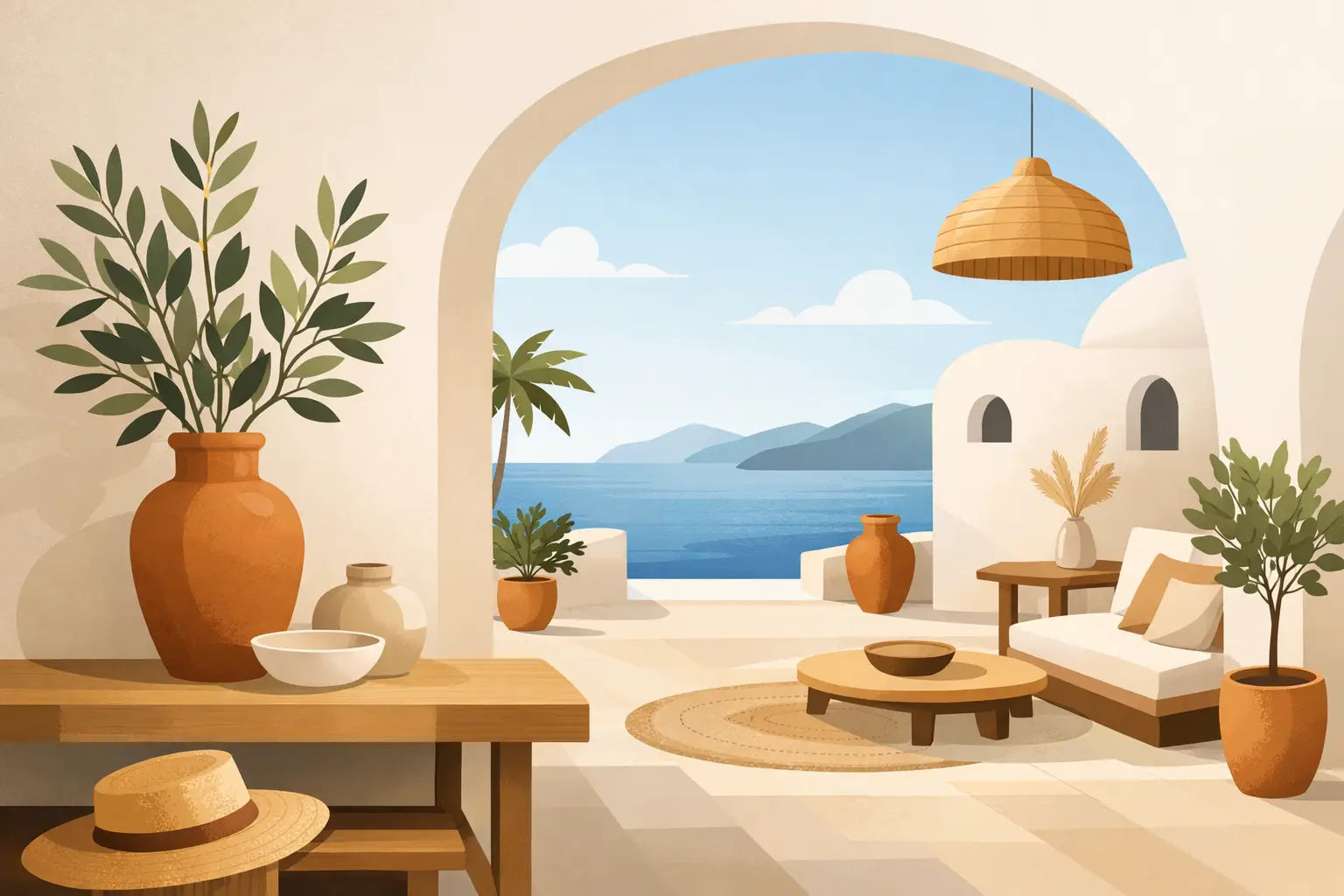
Some homes feel beautiful, and some, in addition, exude a cultivated calm. Elegant Mediterranean decor belongs to this second category: it doesn't seek to impress with excess, but rather to seduce with light, material, and a harmony that seems inevitable. Its sophistication doesn't arise from accumulated ornamentation, but from a precise selection of pieces, textures, and silences.
That is precisely the most common mistake when trying to bring this style into the home. Mediterranean is confused with rustic without nuance, with interiors that are too thematic, or with an aesthetic of perpetual vacation that ends up feeling superficial. The elegant version of this decorative language demands a different perspective: more curated, more serene, and much more aware of the value of materials, craftsmanship, and proportion.
What defines elegant Mediterranean decor
The essence is in restraint. A refined Mediterranean space doesn't compete for attention; it lets the light do its work and the objects speak with their own authority. Clear palettes, warm whites, sands, stone tones, washed blue, and terracotta accents predominate, but always with a sober treatment. Color here accompanies, it doesn't invade.
Material honesty also matters. Wood with visible grain, linen with a natural drape, irregularly finished ceramics, handcrafted copper, or a rug woven by artisans provide a depth that no industrial imitation can replicate. What others call decoration, we call legacy. And in an elegant Mediterranean interior, that difference is immediately perceived.
It's not about filling a room with coastal references, but about building an atmosphere. A well-designed home in this style conveys freshness without coldness, luxury without rigidity, and beauty without artifice. This triple tension is what marks the distance between a passing trend and an aesthetic with permanence.
Light, the true starting point
Before thinking about furniture or accessories, it's worth observing how light enters each room. Elegant Mediterranean decor is organized around this changing clarity that caresses walls, textiles, and surfaces. That's why matte finishes, natural fabrics, and powdery tones work so well: they capture light instead of aggressively bouncing it.
If the space receives abundant natural light, the approach can be especially refined. An off-white base, linen curtains, chalk-toned ceramics, and one or two accent pieces in mineral blue or olive green are enough to create a serene scene. If, on the other hand, the house is darker, it's advisable to work with warm beiges, honey woods, and soft metals to avoid a flat or overly cold result.
Artificial lighting should also accompany this idea. Better a few well-thought-out sources than general, characterless lighting. Sculptural wall lights, table lamps with textile shades, or reinterpreted lanterns with a contemporary language help sustain the intimate atmosphere the style needs as evening falls.
Noble materials and real patina
If this style had to be condensed into a single decision, it would be this: choose less, but choose better. Elegant Mediterranean decor depends on materials that age with dignity. Much of its magnetism lies there.
Linen is almost essential for its ability to provide lightness without losing presence. It works in curtains, cushions, tablecloths, and bedding, especially in ivory, sand, or grayish-blue tones. Artisan ceramics introduce irregularity and relief, two necessary qualities to prevent the ensemble from appearing excessively calculated. And metals, when they appear, should do so with intention: an Anatolian copper piece, a hammered tray, or an aged brass detail elevate the space without making it ostentatious.
Rugs deserve a separate mention. Compared to uniform and predictable options, a hand-woven piece adds pattern, history, and visual warmth. A kilim in a desaturated palette can organize an entire living room or add depth to a bedroom with clean lines. The nuance here is important: the richer the textile work, the more refined its surroundings should be.
How to compose without excess
Mediterranean sophistication needs breathing room. A sculptural vase looks better when it's not competing with ten smaller objects around it. A noble wood console calls for a measured composition, not an accumulation of accessories. Elegance, in this style, is very similar to editing.
In the living room, for example, it's best to start with a calm base: a sofa in natural fabric, a coffee table with material presence, and a rug with personality. From there, layers are introduced. A ceramic bowl, a generously textured throw, a table lamp, and one or two cushions with artisanal patterns can be enough. When each piece has origin, craftsmanship, and character, nothing more is needed.
In the dining room, the table takes on an almost ritualistic role. Washed tablecloths, soulful tableware, sober glass, and organic centerpieces create a much more refined scene than any overloaded arrangement. Mediterranean beauty doesn't need grandiosity; it needs discernment.
Elegant Mediterranean decor in every room
Living Room
The living room should feel bright, welcoming, and serene. The mix of contemporary volumes and artisanal accents works especially well here. A clean-lined sofa can coexist with a crafted copper side table or Ottoman-inspired ceramics if the palette remains coherent. The balance lies in not turning the room into a showcase of valuable pieces, but in letting one or two speak clearly.
Bedroom
In the bedroom, the most luxurious version of Mediterranean style is expressed through touch. Washed linens, dense cottons, light bedspreads, and a rug that softens the morning completely change the experience of the space. Colors should invite rest: ivory, sand, stone, soft taupe, or misty blue. A bedroom with too much contrast loses that enveloping quality so characteristic of the style.
Bathroom
Few rooms benefit as much from this decorative language as the bathroom. High-quality towels, artisan ceramics for small objects, beautiful soap dishes, a mirror with an honest frame, and aromatherapy notes turn the functional into a ritual. Here, luxury is not showy; it's sensory.
Terrace or garden
The elegant Mediterranean exterior avoids folklore. Better sober textiles, sculptural pots, warm lighting, and simple-lined furniture. If patterns are added, they should be few and well-chosen. The terrace should extend the house, not look like a separate stage.
The role of craftsmanship in a soulful interior
There's a reason why certain spaces linger in memory. It's not just their beauty, but the sense of truth they convey. Craftsmanship introduces that dimension. A handmade piece contains small variations, slow processes, and human decisions. This controlled imperfection is precisely what gives depth to an elegant interior.
In an era saturated with interchangeable objects, choosing pieces with artisanal lineage is also a form of aesthetic positioning. It speaks of a more discerning, less impulsive gaze, more connected to permanence. Casa Serena Interiores understands this sensibility by bringing together objects born in workshops where material is still worked with memory, not with haste.
However, it's important to avoid a literal or overly ethnic interpretation. The key is not to fill the house with exotic-looking pieces, but to integrate them into a contemporary and serene framework. A special ceramic piece has more impact on an uncluttered table. An extraordinary textile breathes better in a sober bedroom. Authentic luxury rarely needs to be underlined.
Common mistakes when seeking this style
One of the most common is overusing white without introducing enough layers of texture. The result can be correct, but also impersonal. Another mistake is confusing naturalness with carelessness: organic finishes must coexist with rigorous composition, or the space loses sophistication.
Mixing references also often fails. Not all artisanal items fit within an elegant Mediterranean decor. There are wonderful pieces that, nevertheless, break the harmony due to scale, shine, or color. Having a good eye means giving up beautiful objects when they don't belong to the room's narrative.
Finally, it's worth remembering that this style doesn't require replicating a seaside villa. It can thrive in an urban apartment, a contemporary house, or a classic renovation, as long as there is a coherent relationship between light, materials, and selection. More than a theatrical setting, it's a way of understanding home.
An elegant Mediterranean house is not composed of quick formulas. It is built with time, with tact, and with pieces that deserve to remain. When light meets noble material and craftsmanship finds space to breathe, the home stops being merely decorated and finally begins to have a soul.


