


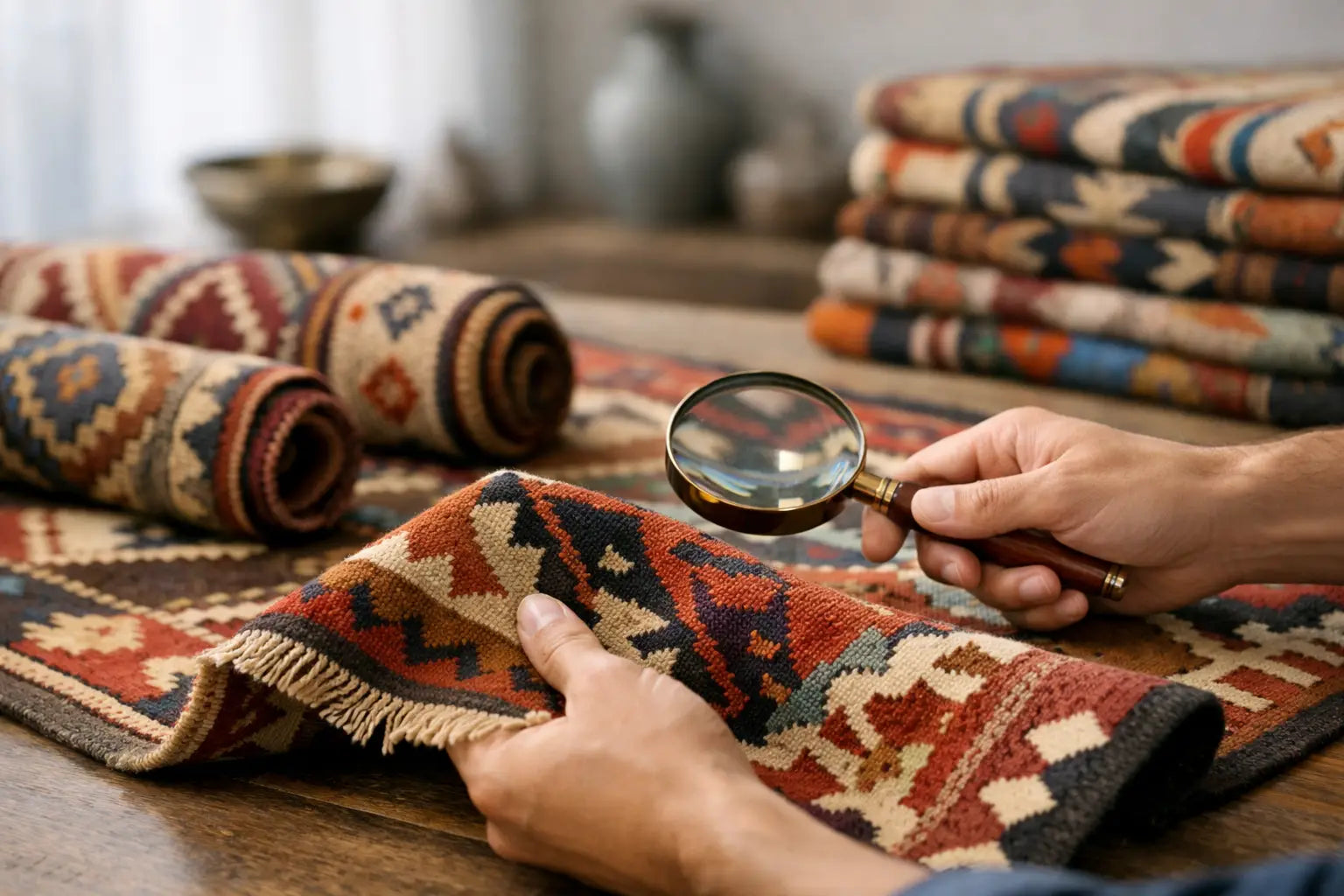
A Turkish kilim can change the entire atmosphere of a room in a single gesture. Not with excess, but with character. If you are wondering how to choose a Turkish kilim, the real question is not simply which rug to buy, but which piece has the right presence for your home, your eye, and the way you want a space to feel.
Unlike pile rugs, kilims are flatwoven. That gives them a lighter visual rhythm and a certain architectural clarity. They can soften a room without making it heavy, bring history into a pared-back interior, or add warmth to a coastal scheme that needs depth. The best ones do not look styled in. They look as though they have always belonged.
How to choose a Turkish kilim for your space
The first decision is practical, but it is also aesthetic. Start with where the kilim will live. A large sitting room kilim must anchor furniture and create a sense of composition, while a hallway runner needs resilience and movement. A bedroom kilim can be gentler in tone and more intimate in scale.
Size is where many beautiful choices go wrong. A kilim that is too small can make a room feel fragmented, especially in larger reception spaces. In a sitting room, it is usually better for at least the front legs of the sofa and chairs to rest on the rug. In a dining area, the kilim should extend beyond the table so chairs remain on the weave when pulled out. In narrower spaces such as hallways or beside a bed, a little breathing room around the edges often looks more refined than wall-to-wall coverage.
It is worth thinking about proportion before pattern. A restrained kilim in the right size will always feel more luxurious than an extraordinary one that sits awkwardly in the room.
Consider how the room is used
Turkish kilims are wonderfully versatile, but they are not all suited to the same level of wear. In a family room or entrance hall, a denser weave and darker ground can be more forgiving. In a guest bedroom or reading corner, you may have the freedom to choose something lighter, softer in colour, or more delicate in mood.
This is where lifestyle matters. If you have children, pets, or a house that is constantly in motion, practicality should not be treated as a compromise. It is simply part of good curation. A kilim that ages gracefully under daily life is often the wiser choice than one you are afraid to live with.
Look first at material and weave
When people fall in love with a kilim online, they often respond to pattern first. Yet material is what determines how the piece will live over time. Traditional Turkish kilims are commonly woven from wool, sometimes with cotton foundations. Good wool has a softness and resilience that improves with age. It holds dye beautifully, wears in rather than simply wearing out, and carries that subtle, matte richness that machine-made fibres cannot imitate.
A flatwoven structure means there is no pile to obscure the pattern. Every motif is part of the textile itself. That gives a Turkish kilim its graphic strength, but it also means quality is visible. You can often sense a fine weave in the precision of the design, the balance of the edges, and the suppleness of the cloth.
Handwoven pieces tend to have small irregularities. These are not flaws. They are the signature of the maker's hand. In fact, a kilim that feels too perfect can sometimes feel less alive.
Wool, age and finish
Older kilims often have extraordinary patina. Colours soften, the surface relaxes, and the piece gains that elusive quality collectors recognise immediately. But age alone does not make a kilim desirable. Some vintage examples are worn too thin for heavy use, while others have been beautifully preserved and remain robust enough for everyday living.
Newer handwoven kilims can be equally compelling, especially when produced by skilled Anatolian workshops using traditional methods. They may offer stronger structure, fresher colour, and easier placement in contemporary interiors. The decision between vintage and newly woven often comes down to what kind of atmosphere you want - weathered soul or crisp clarity.
Colour should guide the mood, not dominate it
One of the great pleasures of choosing a Turkish kilim is colour. Earthy terracottas, softened indigo, faded saffron, olive, madder red, chalky cream - these tones speak beautifully to Mediterranean interiors because they feel sun-touched rather than synthetic.
Still, the right palette depends on the room. If your interior already carries strong materials such as marble, dark timber, antique brass or patterned upholstery, a quieter kilim can bring balance. If the room is largely neutral, a more expressive weave may provide exactly the layer of life it needs.
It helps to think in terms of dialogue rather than matching. Your kilim does not need to repeat the exact shades in the room. It should converse with them. A warm red can illuminate cool stone floors. A faded blue can calm rooms with golden light. A sand and tobacco palette can add gravitas to crisp white walls.
If you are between two options, choose the one with greater nuance. Colours with slight variation tend to sit more elegantly in a space than shades that appear flat or over-saturated.
Pattern, symbolism and visual weight
Turkish kilims carry a language of motifs, many rooted in Anatolian weaving traditions. Geometric medallions, hands-on-hips figures, ram's horn forms, stars and protective symbols all bring meaning as well as decoration. You do not need to decode every motif to appreciate a kilim, but understanding that these are not arbitrary patterns adds depth to the purchase.
Pattern scale matters enormously. A bold, large-scale design can ground a minimal room with confidence. A finer, more repetitive pattern may be easier to place in layered interiors with ceramics, books, upholstery and collected objects. Neither is better. It depends on whether you want the kilim to be the focal point or part of a broader composition.
Visual weight is just as important as colour. Some kilims feel airy and open, others strong and emphatic. In a small room, an intensely busy design can feel crowded. In a large room, a very slight pattern may disappear. The most successful choice usually strikes a balance between personality and proportion.
How to choose a Turkish kilim with confidence
Authenticity matters, especially in a market crowded with decorative imitations. A genuine Turkish kilim should come with clear information about where it was made, what materials were used, and whether it is vintage or newly woven. Provenance is not a romantic extra. It is part of the value.
Look for signs of real craftsmanship: hand-finished edges, a weave with character, natural variation, and materials that feel honest rather than glossy. If a seller cannot tell you anything about origin, weaving region or fibre content, caution is reasonable. The finest artisan pieces carry not only beauty, but traceability.
This is where a discerning retailer makes a difference. A carefully sourced kilim from an Anatolian maker or specialist collection offers something mass-market reproductions cannot - integrity. At Casa Serena Interiores, that integrity is part of the attraction. The object enters your home with its story intact.
Price and value are not the same thing
A Turkish kilim can vary significantly in price depending on age, rarity, materials, condition, size and craftsmanship. It is tempting to compare pieces by dimensions alone, but that rarely tells the full story. A modestly sized kilim with exceptional wool, luminous natural dyes and fine weaving may hold greater long-term value than a larger but ordinary piece.
The better question is whether the kilim will still move you after seasons of living with it. The right one earns its place slowly and then keeps it for decades.
A well-chosen Turkish kilim does more than complete a room. It steadies it. It introduces memory, texture and a kind of quiet authority that trend-led interiors can never quite achieve. Choose with your eye, certainly, but also with patience. The piece that belongs to you usually announces itself not by shouting, but by making everything around it look more considered.


