


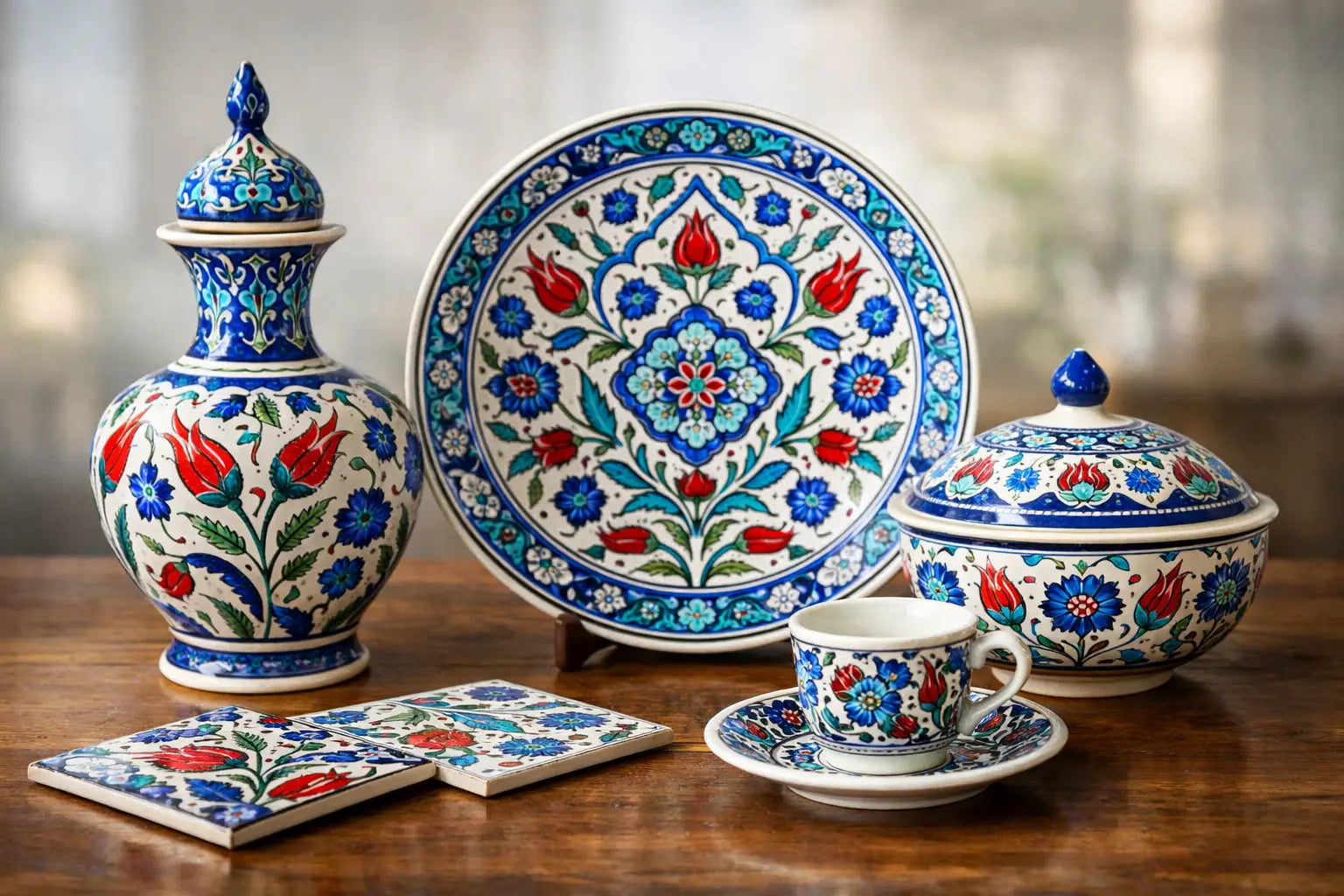
A hand-painted plate in luminous cobalt, coral red and emerald green can change the atmosphere of a room faster than a piece of furniture. That is the quiet power behind the question, what is Iznik pottery? It is not simply decorative ceramics from Turkey. It is one of the most refined artistic traditions of the Ottoman world, shaped by court taste, technical brilliance and a visual language that still feels astonishingly modern in a beautifully considered home.
What is Iznik pottery?
Iznik pottery refers to the celebrated ceramic tradition that flourished in the town of Iznik in north-western Anatolia, especially during the 15th to 17th centuries under the Ottoman Empire. These works were prized for their white body, brilliant glaze and richly painted surfaces, often featuring tulips, carnations, hyacinths, saz leaves, geometric motifs and elegant arabesques.
At its height, Iznik production supplied palaces, mosques and elite households. Tiles adorned imperial architecture, while dishes, bowls, ewers and chargers brought artistry into daily life. What makes Iznik so compelling today is the balance it achieves - formal yet alive, ornamental yet restrained, historical yet remarkably at ease in contemporary interiors.
When people ask what is Iznik pottery, they are often really asking why it looks so distinct. The answer lies in a rare combination of material innovation and artistic discipline. The surfaces are crisp, the palette is unmistakable and the motifs hold movement without chaos. Even a single piece carries presence.
The origins of Iznik pottery in Ottoman culture
Iznik was once known as Nicaea, a town with deep Byzantine and later Ottoman significance. By the 15th century, it had become an important centre of ceramic production. Ottoman court patronage changed everything. Demand from Istanbul encouraged workshops to refine both technique and design, elevating local pottery into a sophisticated art form associated with power, learning and cultivated taste.
This was not folk pottery in the casual sense. Much of it was made within a highly developed visual culture tied to the imperial court. Designs often echoed manuscript illumination, textile pattern and architectural ornament. That cross-pollination gave Iznik ceramics their elegance. They did not emerge in isolation, but as part of a larger aesthetic world in which craftsmanship was treated as a serious cultural language.
There were outside influences too. Early blue-and-white wares show the impact of Chinese porcelain, which was admired at the Ottoman court. Yet Iznik never became a mere imitation. Turkish makers transformed those references into something more fluid and botanical, more closely tied to Ottoman tastes and the flora of the region.
Why Iznik pottery looks the way it does
The beauty of Iznik lies partly in its technical structure. Unlike heavy earthenware, classical Iznik ceramics were made with a fritware body - a composition using finely ground quartz alongside glassy elements and clay. This helped create a pale, smooth surface that could support sharply defined painted decoration beneath a transparent glaze.
That white ground matters. It gave colours extraordinary clarity and allowed motifs to breathe. Cobalt blue came first, followed by turquoise, sage green, black outlining and, most famously, a raised bole red that gave later pieces their warmth and depth. True coral red became one of the signatures collectors and connoisseurs still look for.
The designs themselves are equally important. You see repeating flowers, cypress trees, scrolling vines, feathered leaves and rhythmic borders that feel architectural without becoming rigid. There is almost always a sense of order, but never lifeless symmetry. A fine Iznik piece has movement in the line, confidence in the spacing and a delicacy that reveals the painter's hand.
The classic motifs that define Iznik pottery
Certain images return again and again in Iznik work because they held meaning in Ottoman visual culture. The tulip, now almost inseparable from Turkish decorative arts, suggested elegance and refinement. Carnations and roses introduced softness and courtly beauty. Saz leaves, long and serrated, added drama and direction.
Geometric patterns and arabesques connected Iznik to the wider Islamic decorative tradition, where repetition and abstraction carried both intellectual and spiritual resonance. In tile panels, these motifs could create a sense of serenity across an entire wall. On a bowl or dish, they offered intimacy - pattern scaled to the hand, the table and the rituals of hospitality.
For an interior today, this matters. Iznik motifs have enough character to anchor a room, yet enough discipline to sit comfortably with linen, marble, aged wood, brass and quiet plaster tones. They are decorative, certainly, but never frivolous.
From palace walls to modern interiors
Part of Iznik pottery's enduring appeal is that it was always both architectural and domestic. Some of its most spectacular uses appear in mosques, mausoleums and pavilions across the Ottoman world, where tiles turn walls into fields of colour and pattern. But the tradition also includes serving dishes, vases and decorative vessels intended for lived spaces.
That duality is why it translates so well into refined homes now. A single Iznik-style platter displayed above a console introduces history without heaviness. A grouping of hand-painted bowls on open shelving can soften a minimalist kitchen. In a garden room or coastal dining space, the palette feels especially luminous against natural light.
There is, however, a difference between using Iznik as a statement and over-styling it. These pieces have enough visual authority that they rarely need competition. One substantial charger on a wall may feel more luxurious than an entire crowded arrangement. The most persuasive rooms give artisan ceramics air around them.
Authentic Iznik, antique pieces and modern Iznik-style ceramics
This is where nuance matters. Not every piece described as Iznik is an original work from the Ottoman period, and not every modern ceramic inspired by Iznik should pretend to be. Antique Iznik pottery is rare, culturally significant and often held in museums or serious collections. Pieces on the market can command very high prices, and provenance matters enormously.
Modern Iznik-style ceramics are a different category. The best of them honour historical methods, motifs and regional craft knowledge while remaining transparent about their date and production. For many collectors, designers and homeowners, this is precisely the point. They are not looking for a museum relic. They want a beautifully made object that carries the spirit of the tradition into a home that is lived in.
A hand-painted contemporary piece can still possess integrity, especially when it comes from workshops with real ties to Turkish ceramic heritage. The trade-off is simple. If your priority is historical rarity, you enter the world of antiques and scholarship. If your priority is craftsmanship, beauty and everyday placement, contemporary Iznik-style porcelain and ceramics may be the wiser and more practical choice.
How to recognise quality in Iznik-inspired ceramics
Quality reveals itself in restraint. Look first at the line work. Fine pieces have clean, confident outlines and motifs that feel balanced rather than crowded. The colours should be vivid but not harsh, with enough variation to show hand application rather than flat mechanical printing.
Then consider the surface. Good ceramics have depth in the glaze and a sense of finish that feels silky rather than dull. On hand-painted work, slight irregularities are often a virtue. They remind you that a person, not a machine, guided the brush.
Shape matters too. A beautifully proportioned bowl or plate allows the pattern to sit naturally. Poorly made forms can cheapen even a competent design. If you are buying for a sophisticated interior, think about the piece as an object first and a motif second.
For those who care about provenance, ask where it was made, how it was decorated and whether it was sourced from genuine artisan workshops. This is one reason discerning buyers turn to carefully curated collections such as Casa Serena, where the story of the maker is treated as part of the value, not a marketing afterthought.
Why Iznik pottery still feels relevant
Trends come and go, yet Iznik continues to speak to people who want their homes to feel layered, travelled and deeply considered. That endurance is not accidental. It comes from a design language rooted in harmony, craftsmanship and cultural memory.
In a market crowded with decorative objects that imitate character without possessing any, Iznik offers something rarer: beauty with lineage. It carries the discipline of a long tradition, but it also brings pleasure in the immediate sense - colour on a shelf, pattern against stone, the gleam of glaze in afternoon light.
Perhaps that is the most honest answer to what is Iznik pottery. It is a ceramic tradition born in Ottoman Anatolia, yes. But for the home, it is also a way of choosing objects with soul over objects with mere surface. If you are building rooms meant to last, that distinction is everything.


