


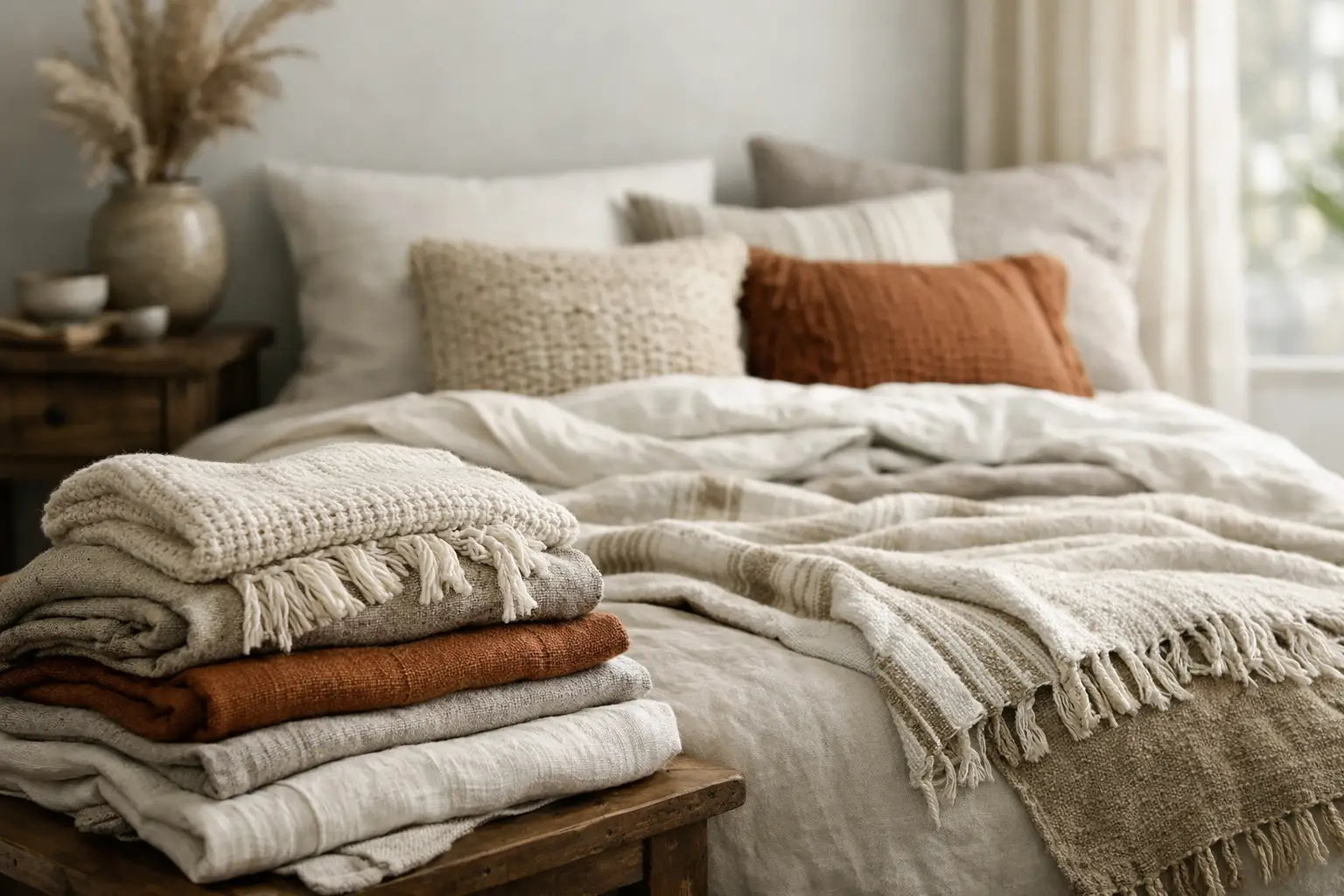
A room rarely feels memorable because of one beautiful piece alone. More often, it is the way linen softens timber, how a handwoven rug grounds a quiet seating area, or how a striped peshtemal thrown over the arm of a chair makes the whole space feel lived in rather than staged. That is the real art in how to layer artisan home textiles - not adding more for the sake of it, but composing warmth, depth and personality with intention.
For homes shaped by a Mediterranean sensibility, textiles do far more than decorate. They temper stone, lighten dark wood, bring grace to practical rooms, and introduce the human touch that prevents a polished interior from feeling cold. When those textiles are handmade, carrying the irregular beauty of the loom, the dye bath and the maker's hand, layering becomes even more powerful. The room begins to feel collected, not purchased in one sweep.
Why layered textiles make a room feel complete
The most compelling interiors hold a conversation between surfaces. Smooth marble needs softness nearby. Crisp ceramics benefit from the quiet weight of a woven cloth. A pared-back sofa often looks richer with cushions in varied weaves rather than a matching set chosen too quickly.
This is why artisan textiles matter. They bring texture that cannot be replicated by flat, factory-perfect finishes. A kilim with subtle abrash, a washed cotton coverlet, a fringed peshtemal or an embroidered cushion each catches light differently. Together, they create a room that feels settled and deeply personal.
There is, however, a difference between layering and cluttering. The aim is not to crowd every surface with fabric. It is to vary texture, scale and drape so the eye moves naturally through the room. Restraint is part of the luxury.
How to layer artisan home textiles from the ground up
The easiest way to approach layering is to start where the room visually rests - the floor - and build upward. This creates a sense of order and prevents decorative decisions from feeling scattered.
Begin with the anchor textile
Every room benefits from one textile that holds the scheme together. In a sitting room, that is usually the rug. In a bedroom, it may be the bed covering. In a dining space, it could be the table linen if the room is otherwise spare.
Choose this anchor for its tone and character rather than trend. A handwoven Turkish rug in sun-faded terracotta, indigo, oat or soft olive offers enough presence to guide the rest of the room without dictating every colour choice. If the pattern is intricate, let the surrounding textiles breathe. If it is understated, you have more freedom to introduce embroidery, stripe or fringe elsewhere.
This is where many homes lose their sense of ease. If the foundation textile is too loud and every layer competes with it, the room feels restless. If the foundation is too timid and everything else is similarly quiet, the room can feel unfinished. Balance always depends on contrast.
Add a second layer in a different texture
Once the anchor is established, introduce a second textile that changes the tactile language of the room. If your rug is tightly woven, bring in something softer such as brushed cotton cushions, a slubbed linen throw or a quilted bed cover. If your base textile is airy and relaxed, add a denser weave to create gravity.
Texture should shift before colour does. This is the distinction that gives refined interiors their depth. Two fabrics in almost the same shade can still feel rich together if one is crisp, one nubby, one gently washed and another slightly lustrous.
In Mediterranean-inspired spaces, this interplay is particularly beautiful because the palette often remains restrained. Chalk, sand, sea blue, tobacco, pomegranate and olive do not need heavy saturation when the materials themselves are expressive.
Think in families of colour, not exact matches
Matching is the enemy of a collected room. Artisan textiles are most elegant when they appear related rather than coordinated in an overly literal way.
Instead of trying to repeat one exact blue across cushions, throws and table linens, think in a wider family - faded denim, deep Aegean, soft mineral blue and blue-grey. The same applies to neutrals. Cream, flax, almond and stone sit more naturally together than a single shade repeated too precisely.
This approach also honours handmade variation. Natural dyes, hand-finishing and small-batch production carry subtle tonal shifts, and that is part of their beauty. Rather than forcing uniformity, let those nuances remain visible.
There are moments, of course, when a stronger contrast is needed. A largely neutral room may need one note of saffron, rust or emerald to avoid looking too polite. But that accent should feel deliberate, like jewellery, not noise.
Use pattern with discipline
Pattern gives life to layered textiles, yet it needs spacing. A room full of motifs can quickly lose its elegance, particularly when each design demands equal attention.
A useful principle is to vary the scale. If your rug carries a detailed geometric pattern, pair it with larger, quieter forms elsewhere - perhaps a broad stripe, a simple border or a plain weave. If your bed linen is mostly solid, you can be more expressive with embroidered cushions or a patterned runner at the foot of the bed.
Traditional Anatolian and Ottoman-inspired motifs sit beautifully in contemporary homes when they are not overexplained. One or two patterned elements often feel more luxurious than five. Let each piece breathe enough to be seen.
Where layering should feel looser
Not every room asks for the same degree of structure. Bedrooms and sitting rooms can carry more textile richness because they are naturally spaces of comfort. Kitchens, bathrooms and garden settings often benefit from a lighter hand.
In a bathroom, for instance, a beautifully woven peshtemal, a robe in a complementary tone and perhaps a small rug may be all you need. The effect is elegant because it remains spare. In a kitchen or dining area, table linens can take centre stage, supported by seat cushions or a runner, rather than competing with every hard surface.
The lesson is simple: layer according to how the room is used. A house that feels graceful usually reflects practical intelligence as much as aesthetic judgement.
How to layer artisan home textiles in each room
In the sitting room, start with the rug, then soften the seating with two or three cushions in different scales and finishes. Add a throw only where it feels naturally placed - over the arm of a sofa, folded at one end of a bench, or draped lightly across an occasional chair. Too many throws can make even a beautiful room feel overworked.
In the bedroom, think of textiles as a sequence rather than a pile. Begin with breathable bed linen, add a coverlet or matelassé-style layer, then finish with one folded throw and a considered arrangement of cushions. Decorative cushions should never overwhelm the bed itself. Luxury often lives in edit, not abundance.
In the dining room, layering is quieter but no less significant. A washed linen tablecloth, cotton napkins with hand-finished edges, and perhaps seat pads in a related tone create warmth without formality. If the tableware is richly patterned, keep the cloth understated. If the ceramics are simple, the textile can hold more visual interest.
For outdoor spaces, choose textiles that echo the house rather than looking like a separate scheme. Stripes, sun-washed colours and practical weaves work beautifully on terraces and in garden dining areas. The mood should feel effortless, as though the indoors has simply exhaled into the open air.
The value of provenance in layered interiors
There is a quiet difference between layering textiles bought for speed and layering pieces chosen for their origin. The latter gives a room a deeper register. A handloomed towel from the Aegean, a cushion woven in Anatolia, or table linen finished by a small workshop carries narrative as well as beauty.
That narrative matters, particularly in homes where every object is expected to earn its place. Provenance brings soul to styling. It also changes how you live with a piece. You tend to keep it longer, care for it better, and notice the details that mass production often erases.
This is one of the reasons Casa Serena Interiores speaks so naturally to homes that value discernment. When textiles come from real makers and real places, layering becomes an act of curation rather than consumption.
Avoid the room that looks too finished
One final tension is worth keeping in mind. A beautifully layered home should still feel inhabitable. If every cushion is karate-chopped into perfection and every throw arranged with hotel precision, the room can lose its intimacy.
Allow for a little softness. Let the linen crease. Let the woven throw fall slightly off-centre. Let one handmade element interrupt the symmetry. These gestures are not careless. They are what make a home feel gracious, confident and alive.
The loveliest rooms are rarely the most elaborate. They are the ones where texture has been chosen with care, colour has been allowed to breathe, and every textile contributes both comfort and character. When you layer with that kind of discernment, the home does more than look beautiful. It begins to hold memory.


