


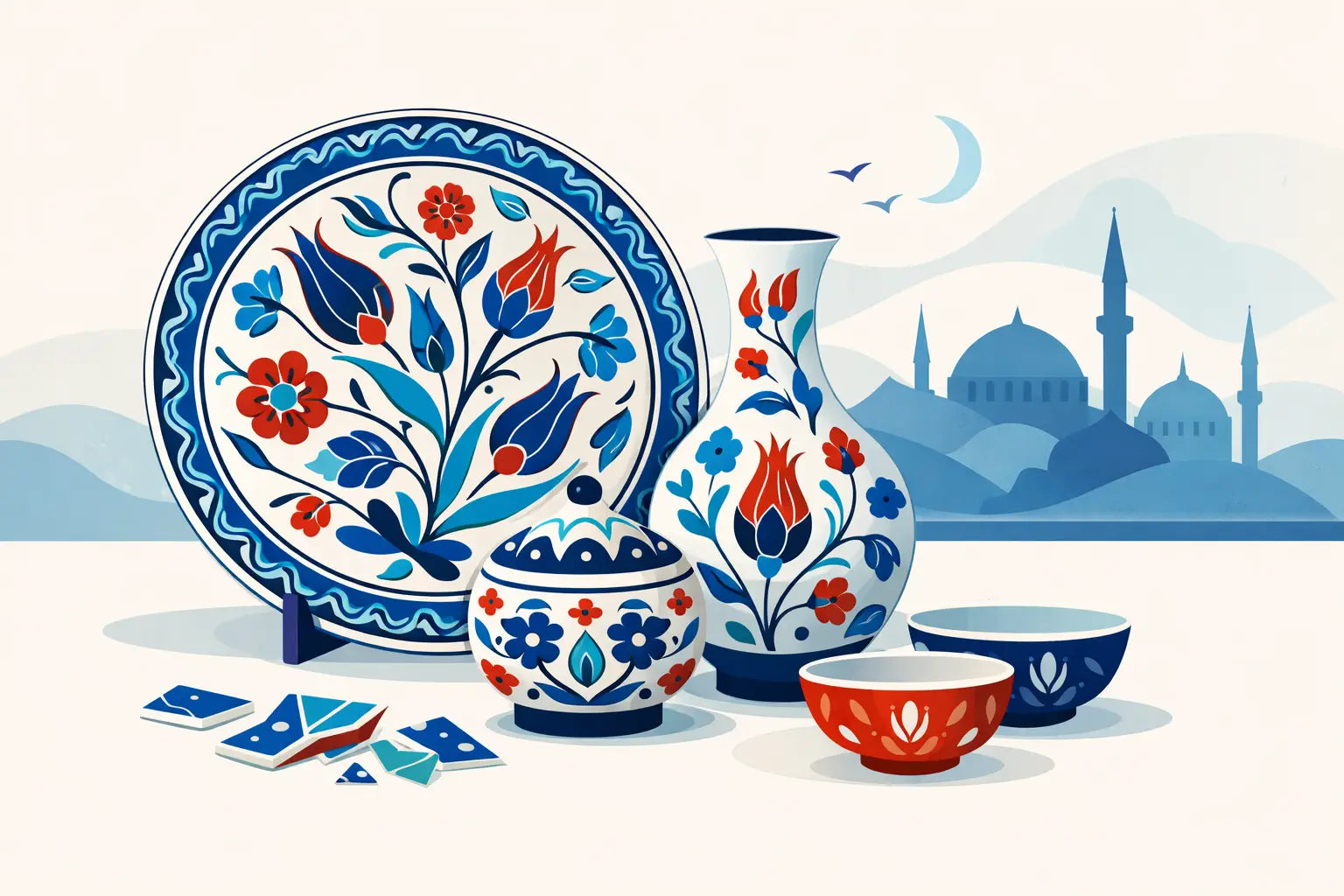
There are pieces that not only decorate a room, but also elevate it. If you've ever wondered what Ottoman ceramics are, the answer isn't a simple aesthetic label. We're talking about an artistic tradition born in the heart of the Ottoman Empire, where clay, color, and ornamental motifs became a language of power, faith, refinement, and daily life.
Ottoman ceramics are, above all, a material expression of a sophisticated civilization. They developed particularly between the 15th and 17th centuries, with famous production centers such as Iznik and, later, Kutahya. Their best examples feature luminous glazes, pure white backgrounds, and an unmistakable decorative repertoire: stylized tulips, carnations, hyacinths, saz leaves, arabesques, cypresses, and geometric compositions that reveal extraordinary visual discipline.
But to reduce them to a mere style would be an understatement. Ottoman ceramics condense a way of understanding beauty: precise, symbolic, and deeply ornamental, though never gratuitous. Each plate, tile, vase, or bowl participates in a tradition where the utilitarian object is elevated to a cultural piece. What others call decoration, we call legacy.
What Ottoman ceramics are in a historical sense
To understand what Ottoman ceramics are, it's useful to place them in their context. The Ottoman Empire was a political, commercial, and artistic power that connected Asia, Europe, and the Mediterranean for centuries. This position fostered a constant exchange of techniques, pigments, courtly tastes, and influences from the Persian, Byzantine, Islamic, and Chinese worlds.
The great golden age came with the workshops of Iznik, a city in western Anatolia that achieved international prestige for the quality of its siliceous pastes and glazes. Pieces were produced there for palaces, mosques, and urban elites. The famous ceramic panels that adorned imperial walls coexisted with plates, jars, and vessels designed for the table and domestic life.
This duality explains part of their magnetism. Ottoman ceramics do not belong only to the museum nor solely to daily use. They inhabit both spheres. They have the nobility of a great tradition and, at the same time, the intimacy of an object that accompanies a domestic ritual.
The features that make them recognizable
Some decorative arts seduce with their rarity, and others with their visual clarity. Ottoman ceramics belong to the second group. Even those unfamiliar with their history often recognize a singular harmony in them.
The first characteristic is color. Cobalt blue was prominent in its early stages, partly inspired by Chinese porcelain valued by the Ottoman court. Over time, turquoise, emerald green, and, above all, a very characteristic coral red or tomato red of certain Iznik pieces were added. It doesn't always appear with the same intensity, and therein lies an important difference between a common reproduction and a more carefully crafted piece.
The second characteristic is vegetal decoration. Tulips, so associated with the Ottoman world, are not a simple floral whim. They embody imperial poetics, an idea of contained elegance and verticality. Carnations, hyacinths, and lanceolate leaves provide movement and rhythm. Often these forms are organized with flexible symmetry, where order is never rigid.
The third characteristic is the balance between ornamental density and clean background. Many pieces are richly decorated but still breathe. The white doesn't disappear; it acts as a visual pause. This quality explains why, centuries later, they still work so well in contemporary interiors.
Iznik, Kutahya, and the differences that matter
When speaking of Ottoman ceramics, Iznik often takes center stage. This is understandable, but it is not the only reference. Kutahya also played a decisive role, especially after Iznik's decline.
Iznik is associated with technical excellence and production more linked to imperial splendor. Its historical pieces are refined, well-proportioned, and confidently drawn. Kutahya, on the other hand, developed invaluable artisanal continuity and more diverse production, sometimes with a more popular or devotional character. It is not a matter of simple superiority. It depends on the era, the use, and the workshop's skill level.
This distinction remains relevant today. In the current market, industrial reproductions, artisanal reinterpretations, and pieces made by workshops that preserve traditional processes with varying fidelity coexist. Therefore, when evaluating a piece inspired by the Ottoman tradition, it is not enough to just look at the motif. One must observe the execution, the glaze, the depth of the color, and the presence of the artisan's hand.
What it represents in a contemporary home
The question is not just what Ottoman ceramics are, but what they do in a home today. And the answer has less to do with nostalgia than with presence.
In a well-designed interior, these pieces add cultural depth without hardening the atmosphere. A large wall plate with Ottoman floral motifs can become the exact focal point in a serene living room. A bowl on a console introduces sparkle, pattern, and a sense of cultivated travel. An Iznik-inspired vase next to linen, washed wood, or limestone creates that Mediterranean dialogue that doesn't need excess to feel luxurious.
Its strength lies in that it doesn't appear impersonal or ephemeral. Compared to mass-produced decoration, Ottoman ceramics suggest time, provenance, and discernment. They speak of a home lived with intention. Of an eye that doesn't buy on visual impulse, but out of affinity for objects that hold memory.
It's also worth noting a nuance. Not every room needs an ornamental profusion. Sometimes a single piece, rigorously chosen, has more impact than a saturated composition. Sophistication rarely depends on accumulation.
How to distinguish a valuable piece from a merely decorative one
Here lies the trickiest part. The rise of artisan aesthetics has multiplied the offer of pieces that imitate the Ottoman style without retaining its technical or cultural depth. At first glance, they may appear striking. In the long run, few stand up to scrutiny.
A valuable piece usually reveals several things at once: good quality clay or porcelain, a well-executed glaze, precise drawing, nuanced color, and a coherent relationship between form and decoration. It doesn't need to be antique to have value. It can be contemporary and excellent if it comes from a workshop that works with a real understanding of the tradition.
Provenance also matters. Knowing where a piece comes from, who made it, and what references it was conceived with completely changes how it's perceived. In a curatorial brand like Casa Serena Interiores, that context is not an added detail, but an essential part of the object's beauty.
Price, of course, plays a role, but not always in the most obvious way. There are very accessible pieces with great artisanal honesty and others that are more expensive, whose value is more about positioning than quality. As with almost everything worthwhile, discernment surpasses immediate impact.
Why it continues to fascinate centuries later
The permanence of Ottoman ceramics is not only explained by their beauty. It is explained because they respond to an idea of luxury that is once again important today: luxury as craftsmanship, as heritage, and as singularity.
In an era of cloned interiors, these pieces offer an alternative with cultural depth. They don't shout, but they are noticed. They don't need extravagance because they possess their own language. And that, for someone seeking a home with identity, is decisive.
Moreover, they connect with a very current sensibility: the revival of noble materials, attention to handmade goods, and the desire to be surrounded by objects that don't seem disposable. Ottoman ceramics embody this aspiration for permanence. Even when presented in contemporary versions, they retain a sense of continuity that calms the space.
There's something more difficult to name and yet central. These pieces contain a form of order. Their patterns, their floral repetition, their chromatic balance produce a strange and refined visual calm. Perhaps that's why they work so well in homes where beauty is sought, but also atmosphere.
A living tradition, not a relic
To think of Ottoman ceramics as a relic of the past would be an elegant mistake, but a mistake nonetheless. Its true value lies in its continued life. In the hands of serious workshops, tradition is not soulfully copied, but interpreted. Scales, uses, and decorative contexts change, but the essential remains: respect for the motif, for the color, and for the dignity of the craft.
This allows it to be integrated today without falling into a themed decor. An Ottoman-inspired piece can coexist with contemporary furniture, minimalist architecture, or a refined Mediterranean language. In fact, that is often where it displays its best version. When it doesn't compete with the space, it ennobles it.
Perhaps that is the best answer to the initial question. Ottoman ceramics are applied art, visual history, and domestic refinement all at once. And when chosen well, they don't just beautify a home. They grant it a depth that is perceived even before it is explained.


