


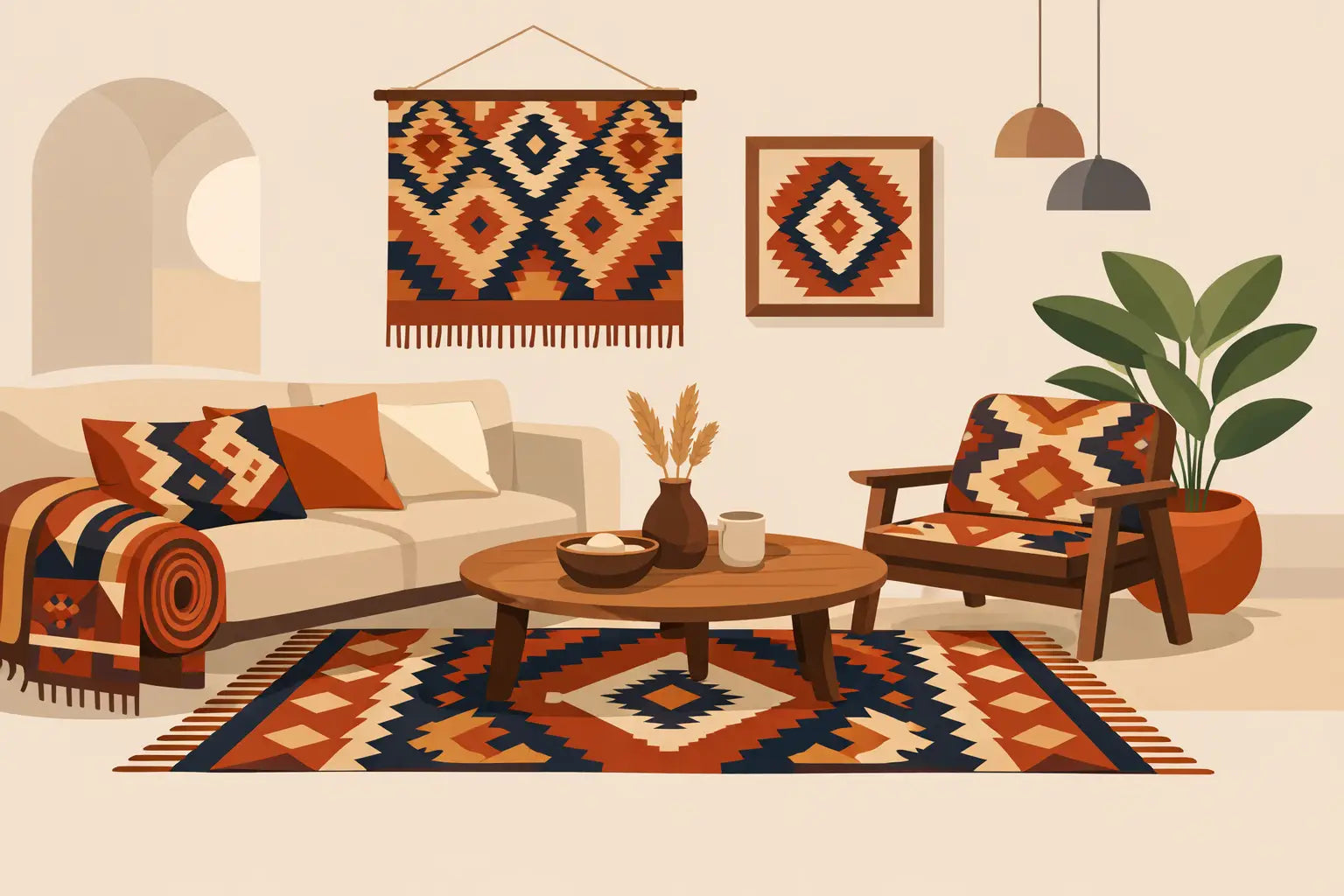
There are correct homes and memorable homes. The difference often lies in a piece that breaks uniformity, introduces history, and visually organizes the space. If you're wondering how to decorate with kilims, the answer isn't about following a trend, but about understanding how a hand-woven textile can bring depth, lineage, and a beauty difficult to imitate.
A kilim doesn't function as a mere accessory. It has graphic presence, texture, and a geometry that dialogues with interior architecture. That's why, when it enters a room, it doesn't just add color: it changes the rhythm of the space. What others call decoration, we call legacy.
How to decorate with a kilim without overwhelming the space
One of the most common mistakes when incorporating a kilim is treating it as if it were a neutral rug. It is not. A well-chosen kilim has its own voice, and that is precisely where its value lies. The key is to give it space to breathe.
In serene interiors, with bases in limestone, linen, aged wood, oak, or white plaster, the kilim provides an elegant tension. It introduces pattern, warmth, and a touch of cultural sophistication without needing to fill the room with objects. If the environment is already very expressive, it's good to compensate. A clean-lined sofa, a sculptural table, or ceramics with restrained glaze allow the textile to maintain its prominence without competing.
Scale also matters. A small kilim lost in a large living room seems accidental. One that's too big can visually flatten the ambiance. The proportion should respond to the furniture and the empty space around it. In a well-designed home, nothing seems improvised, even if it retains a natural feel.
The kilim as an aesthetic starting point
Decorating with a kilim is easier when understood as a foundational piece. Instead of asking what rug fits with the rest, it's better to reverse the process: observe the pattern, tones, and energy of the textile, and build from there.
A kilim in earthy tones, saffron, garnet, or mineral blue can set the entire palette for a room. There's no need to literally repeat its colors. Just pick one for a washed linen cushion, another for a lampshade, and let the neutrals do the rest. Sophistication rarely comes from exact copying. It comes from resonance.
This approach works especially well in homes that seek to escape the catalog aesthetic. An authentic kilim introduces small irregularities, changes in tone, and signs of manual work that no mass production truly reproduces. That's its strength. It doesn't aim to be perfect. It aims to be unique.
In the living room: presence and balance
The living room is, perhaps, the most natural place to start. A kilim under the coffee table defines the conversation, anchors the furniture, and adds a layer of intimacy even in large spaces. If the sofa is light-colored, the contrast usually results in a particularly refined look. If the sofa already has texture or color, it's best to choose a kilim with a more open pattern or a less saturated color scheme.
In contemporary living rooms, the kilim softens the coolness of certain minimalist pieces. In Mediterranean interiors, it amplifies the feeling of a lived-in, luminous home. And in classic settings, it introduces a freer, less predictable note. This versatility doesn't mean anything goes. It means a good kilim knows how to dialogue with different styles without losing its identity.
In the bedroom: silent warmth
In a bedroom, the kilim has a more intimate function. It can be placed at the foot of the bed, on one side to greet the first step of the morning, or even as a runner if the room calls for it. Here, the focus is less on theatrical gestures and more on the feeling of warmth and comfort.
Muted tones, softened reds, sands, and desaturated blues work especially well in serene bedrooms. If the bedding is white or ivory, the kilim adds depth without disrupting the calm. If there are already textile patterns, the rug's design should have a cleaner look. Visual rest is also a luxury.
In the dining room: beauty with discernment
Yes, a kilim can be in a dining room, but it's not always the best decision. It depends on the actual use of the home. If it's a daily dining room with small children, frequent meals, and a lot of activity, you need to consider if you're willing to commit to more diligent maintenance. Beauty has its demands.
That said, in dining rooms with more occasional use, a kilim under the table adds a discreet and very elegant theatricality. Wooden chairs, natural fibers, and artisan-made dinnerware find a magnificent counterpoint in it. The important thing is that the table is well-framed and that the chairs can move comfortably.
How to decorate with a kilim on a wall, bench, or hallway
Thinking of the kilim only for the floor limits its potential. There are pieces with such expressive chromatic quality and design that they deserve an almost artistic reading.
Hung on the wall, a kilim introduces texture where a painting doesn't. It works especially well in entryways, staircases, headboards, or large walls that need soul without excessive volume. In homes with a refined aesthetic, this resource adds a cultured and warm accent. It's not about filling the wall, but about dressing it with a more tactile language.
On a bench, stool, or chest, a small kilim can transform a secondary corner into an intentional scene. In a long hallway, a kilim runner provides continuity and character, turning a transition area into an active part of the home's narrative. Sometimes, the difference between a beautiful space and an extraordinary one lies in those places almost no one looks at first.
Materials and styles that best complement the kilim
The kilim achieves its greatest sophistication when combined with honest materials. Solid wood, artisan ceramics, aged brass, washed linen, marble with subtle veining, or blown glass form a natural conversation with it. These are materials with visual density, with tactile quality, with truth.
On the other hand, when surrounded by overly shiny finishes, imitations, or pieces without aesthetic weight, its richness can become decontextualized. Not because contrast is forbidden, but because not all contrasts are intelligent. An interior with a kilim calls for curatorial intent, not accumulation.
In terms of style, it fits organically into Mediterranean, organic, eclectic, and contemporary interiors with an artisanal sensibility. It can also coexist with certain classical or even industrial codes, as long as there is a basis of balance. The problem is usually not the style. It is usually the lack of criteria when mixing.
Choosing the right kilim: color, scale, and authenticity
Before buying, it's good to honestly assess the space. Does it need energy or calm? To unify or accentuate? A piece that complements or one that leads? These questions are more important than following a color trend.
If the room is bright and neutral, a kilim with greater contrast can add depth. If there's already a lot of visual presence, a more subdued one, with a less dense weave, might be better. Scale, again, is crucial. In artisan pieces, moreover, one must accept that beauty doesn't always conform to rigid symmetry. That slight irregularity is part of its nobility.
Authenticity also matters. A hand-woven kilim not only offers a different material quality; it conveys another relationship with time, with craftsmanship, and with the home that receives it. In a curated selection like that of Casa Serena Interiores, this difference is immediately perceived. They are not interchangeable objects. They are pieces that elevate the space because they were born with history.
Maintenance is also part of luxury
Talking about serene luxury is not talking about fragility, but about attention. A kilim requires certain care to preserve its beauty: rotate it occasionally, avoid excessive sun exposure if the tones are intense, and vacuum it gently. In very active homes, it's wise to consider in which room it will perform best without compromising its integrity.
This should not be seen as a limitation, but as a different way of relating to objects. Pieces with soul are not consumed. They are inhabited, cared for, and inherited. That is, precisely, the kind of beauty that remains when the effect of novelty passes.
Decorating with a kilim is choosing a home with more texture, more intention, and more memory. There's no need to fill every corner or force an exotic aesthetic. Just one good piece, well-placed, is enough for the entire interior to gain depth. When a home incorporates true craftsmanship, it stops looking decorated and finally begins to look lived in.


