


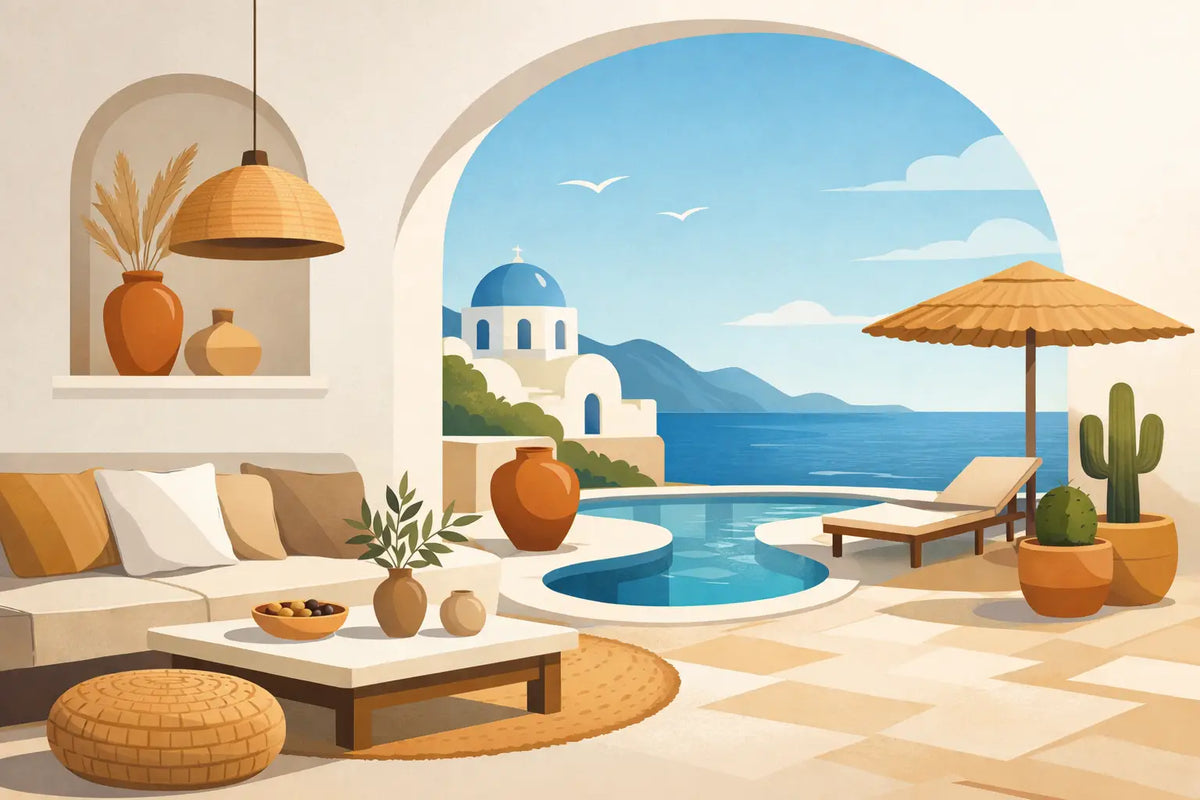
Mediterranean decor trends for 2026 do not chase a flawless home, but rather a home lived in with beauty. In contrast to uniform and accelerated interiors, there is a return to the value of a textured wall, a table marked by use, and a handcrafted piece capable of holding a conversation. The Mediterranean to come is not a postcard: it is a slower, more sensual, and conscious way of inhabiting a space.
The key lies in choosing less, but with greater intention. Honest materials, restrained color, nuanced light, and objects with provenance compose spaces that do not need to show off to convey distinction. What others call decoration, we call legacy.
Mediterranean decor trends 2026: the return of matter
In 2026, sophistication moves away from overly perfect finishes. Lime, washed wood, clay, linen, porous stone, aged copper, and glazed ceramic enter the home with their character intact. It is not about recreating a rural dwelling or filling every corner with coastal references, but about letting materials provide visual depth and a sense of permanence.
Walls gain prominence through mineral plasters, powdery tones, and surfaces that react to light. A plaster white, a warm sand, or a clay pink change their expression throughout the day, something impossible to achieve with a flat and purely decorative palette. This trend works especially well in bright living rooms and bedrooms, where a serene base allows textiles and unique pieces to breathe.
Imperfection, however, requires judgment. A room with too many rustic textures can feel heavy; one with too many smooth surfaces can feel impersonal. Balance appears when combining a mineral base with refined details: a sculptural lamp, delicately patterned porcelain, or a mirror with a worked frame.
Craftsmanship is no longer an accent
Handmade pieces no longer occupy an anecdotal corner. In the most current Mediterranean interiors, they organize the home's narrative. A hand-woven kilim rug can define the living area; an Ottoman fountain can turn an everyday table into a centerpiece composition; an Anatolian copper tray can restore ceremony to the gesture of serving tea or coffee.
The appeal does not lie in two pieces being identical, but precisely in their small variations. A glaze that changes in intensity, an irregular knot, or a patina developed over time are not defects: they are proof of a hand, a craft, and a provenance. For homes that have already moved past catalog decor, that authenticity is the quietest form of luxury.
A palette inspired by the earth, not the marine cliché
Blue is still present, but it loses its automatic role. Instead of dominating walls and cushions, it appears concentrated in deep blue ceramics, a glass lamp, or the pattern of a textile. Around it, the 2026 palette becomes more complex: butter, limestone, light tobacco, muted terracotta, grayish olive, pomegranate garnet, and charcoal black.
These colors provide warmth without turning the house into a themed set. A raw linen sofa gains presence with cushions featuring stripes woven in rust and eggplant tones. A light wood kitchen is refined with cream ceramic bowls and a single cobalt blue piece. The secret is to work in layers and reserve intense contrasts for objects that deserve to be looked at closely.
Warm metal also returns, though with a more sober expression. Hammered copper, aged brass, and bronze finishes replace specular shine. These are materials that appreciate use and dialogue with candlelight at dusk, a small detail that transforms the environment without the need for grand gestures.
The luxury of shadow and low lighting
The Mediterranean light of 2026 does not seek to flood everything. It seeks to modulate, insinuate, and accompany the rhythms of the house. Natural fiber lamps, fabric shades, ceramic sconces, and opal glass luminaires soften the intensity and draw areas of intimacy.
Instead of relying on a single central light point, it is advisable to create three levels: ambient lighting for movement, task light where one reads or cooks, and low points for the evening. A table lamp on a console, a scented candle in the bathroom, or a sconce next to the headboard make the home feel cared for, not simply lit.
This trend comes with a practical warning. Fibers and open shades offer beautiful light, but they are not always enough for a workspace. In those cases, the solution is not to give up on the atmosphere, but to add a directed and discreet source. The most successful design is the one that responds to real life.
Rooms designed for daily rituals
Well-being ceases to be an abstract concept and settles into routines. The bedroom incorporates natural textiles, light layers, and scents that invite you to slow down. The bathroom approaches the idea of a domestic hammam with soft cotton towels, ceramic soap dishes, glass jars, and accessories that turn personal care into a ritual.
In the living room, generous low tables recover their status as a meeting place. There is no need to fill the surface: a characterful tray, a sculptural bowl, chosen books, and a fresh branch are enough. The composition should look spontaneous, even if every element has a reason to be there.
The kitchen also frees itself from the obsession with hiding everything. Handcrafted tableware is displayed on shelves or in cabinets, beautiful utensils remain in sight, and table linens are used daily. A contemporary Mediterranean home does not save its best objects for a hypothetical occasion. It incorporates them into life.
Exterior with the vocation of a living room
Terraces, patios, and balconies are designed as true extensions of the interior. The trends favor built-in benches, stone or wood tables, resistant textiles in earth tones, and terracotta pots of generous proportions. The goal is not to decorate an exterior for a photograph, but to prolong meals, conversations, and long afternoons.
Even an urban balcony can assume this atmosphere. An outdoor-suitable rug, two comfortable chairs, a small table, and a warm light can be enough. The mistake would be to saturate it with plants, lanterns, and accessories until there is no space left to be. The Mediterranean needs air around things.
Pieces with history versus seasonal objects
The great aesthetic decision of 2026 will be choosing what deserves to stay. A handcrafted rug, a well-made lamp, or a collection of ceramics bought little by little withstand the passage of fashion better than a room built with interchangeable novelties. Besides being a more personal choice, it is a way to consume with greater respect for materials and crafts.
Casa Serena Interiores understands this outlook from the direct selection of workshops and pieces that preserve the pulse of Anatolia without renouncing a contemporary reading. Integrating a heritage piece into a current interior does not require reproducing a complete historical aesthetic. It requires knowing how to give it space, light, and company.
To achieve this, it is advisable to choose one protagonist object per room and let the other elements accompany it. A kilim with an expressive pattern asks for quiet sofas; a lamp with great presence needs a clear table; decorated tableware gains strength on a plain tablecloth. Restraint does not reduce luxury: it makes it evident.
The Mediterranean house of 2026 will be less literal and more intimate. It will have traces of craftsmanship, light for every hour, and objects chosen with patience. Start with a piece that truly moves you and allow the rest of the space to find, little by little, its own voice.


