


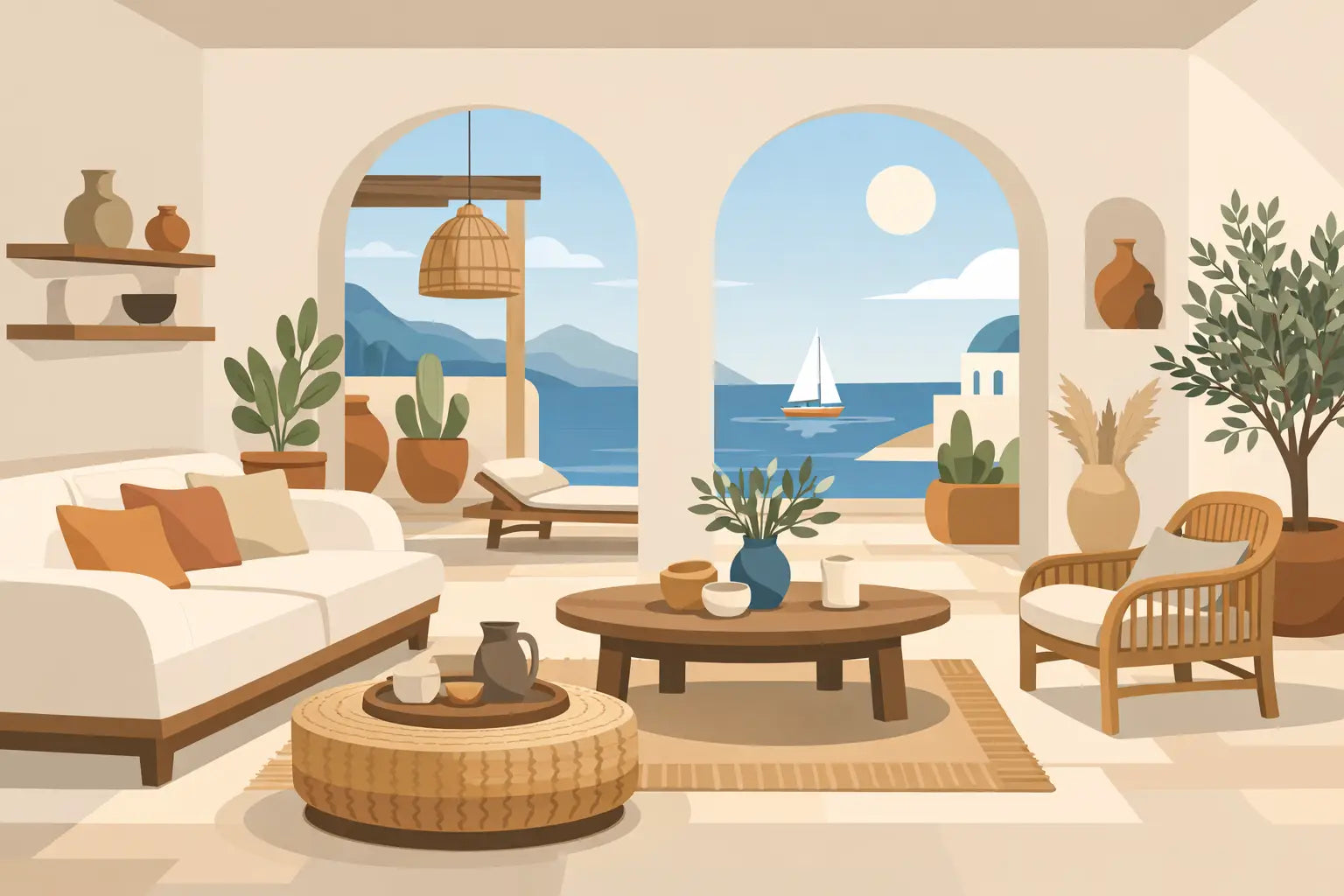
There are living rooms that look pretty, and there are living rooms that feel lived-in, fresh, bright, and deeply personal. When looking for Mediterranean living room ideas, the difference isn't in repeating clichés of white and blue, but in building an atmosphere where light, materiality, and calm have a real presence. The Mediterranean style, when well-interpreted, doesn't scream eternal vacation. It whispers good taste, craftsmanship, and a beauty that seems to have matured over time.
What truly defines a Mediterranean living room
A Mediterranean living room does not depend on a rigid formula. It depends on balance. The architecture usually calls for air, natural light, and a certain connection to the outdoors, but even in an urban apartment, this feeling can be achieved if the palette, materials, and selection of pieces are well-managed.
The key is to avoid two common mistakes. The first is falling into a thematic, almost theatrical, version, full of obvious and unrefined visual anchors. The second is making it so neutral that it loses its soul. The authentic Mediterranean has serenity, yes, but it also has patina, craftsmanship, contrast, and sensory layers.
12 ideas for a Mediterranean living room with serene elegance
1. Start with a mineral and luminous base
Walls and large volumes should breathe clarity. Off-whites, ivories, sand, limestone, warm greige, or stone tones create that silent background that allows other elements to gain depth. Not everything has to be pure white. In fact, a too-cold white can ruin the overall warmth.
If the space receives little light, matte finishes and creamy tones with a sunny undertone are suitable. If the living room is very bright, a more toasted beige or a wall with a plaster texture can be introduced to add relief without darkening it.
2. Introduce wood with an honest appearance
Wood in a Mediterranean living room should look like material, not varnish. Washed oak, light walnut, aged elm, or wood with visible grain provide roots and counterbalance the lightness of white. A solid coffee table, a discreet console, or exposed beams can completely change the perception of the space.
Here, moderation is key. Too much dark wood feels heavy. Too little makes it cold. The sweet spot is mixing light surfaces with one or two pieces of strong presence.
3. Use textiles that add history, not just color
The Mediterranean living room relies heavily on texture. Washed linen, thick cotton, light wool, and artisan fabrics achieve that feeling of a sophisticated yet livable home. Cushions and throws shouldn't be chosen just for coordination, but for their ability to add tactile depth.
A hand-woven kilim rug works particularly well because it introduces rhythm, memory, and a geometry that avoids monotony. In very neutral spaces, a textile piece with a traditional pattern and faded colors can act as the aesthetic heart of the room. What others call decoration, we call legacy.
4. Let ceramics play a leading role
Few things better explain Mediterranean sensibility than a good collection of ceramics. Terracotta vases, glazed bowls, artisan pieces in ivory, petrol blue, or olive green tones bring an imperfect beauty that enlivens shelves, tables, and sideboards.
It's not necessary to fill every surface. Sometimes three well-chosen pieces, with volume and presence, are enough to elevate the ensemble. The difference between a correct living room and a memorable one is often there, in discernment, not in quantity.
5. Work with a coastal-inspired palette, but with restraint
The Mediterranean imaginary invites blues, greens, and earthy tones. The question is how to incorporate them. An elegant living room doesn't need to literally reproduce the sea. It needs to evoke it. Indigo blue in a textile, sage green in a ceramic, toasted sand in the rug, aged copper in a luminous detail.
If too much contrast is introduced, the space can become thematic. If everything remains beige, it runs the risk of looking flat. The best combination is usually a neutral base with two or three well-dosed accents.
6. Choose warm lighting with artisanal character
Light in a Mediterranean living room should envelop. During the day, it's favored by light curtains that filter without blocking. At night, the atmosphere is built with table lamps, wall sconces, or lanterns made of noble materials that project a warm, low light.
Textured glass, ceramic, brass, or worked copper add special value because they turn lighting into a sculptural object. It's not just about seeing well, but about the living room changing its mood as evening falls and gaining intimacy.
7. Mix natural fibers without turning the living room into a rustic postcard
Rattan, jute, esparto, or wicker can work wonders in a Mediterranean key, as long as they are used with intention. An armchair, a lampshade, or a well-chosen basket add organic lightness. But if these fibers are overused, the living room can veer towards an excessively informal style.
The solution is to balance them with more refined elements, such as a stone table, an enveloping upholstery, or a highly decorative ceramic. Sophisticated Mediterranean style thrives on this dialogue between simplicity and nobility.
8. Create layers with pieces of provenance, not generic objects
A living room with identity is not created by trends. It is built with pieces that seem to have been chosen over time. An Anatolian copper bowl, an Ottoman-inspired ceramic tray, an Aegean textile draped over the arm of a sofa, or a decorative piece that reveals hand, craft, and origin provide a silent richness that mass retail rarely can offer.
This is one of the most effective ideas for a Mediterranean living room if you want a truly mature result. Provenance shows. And when it shows, the space gains conversation, depth, and status without the need for ostentation.
9. Make the sofa a refuge, not a visual block
The ideal sofa for this style has generous proportions, gentle lines, and natural upholsteries. Linen, cotton blends, and washed textures fit better than overly technical or shiny fabrics. Raw tones, soft taupe, or sand work as an excellent base.
If the living room is small, it's advisable to avoid excessively bulky models. If it's spacious, a low and deep sofa helps create that sense of elegant rest so characteristic of well-designed Mediterranean homes.
10. Introduce metal with patina and measure
The right metal doesn't cool the atmosphere, it refines it. Copper, aged brass, and certain forged finishes provide warm glints very useful for breaking the hegemony of neutrals. They can appear in a lamp, a tray, a side table, or small decorative accents.
The important thing is not to scatter them without criteria. In a Mediterranean living room, metal works best as jewelry: a few pieces, well placed, and with visible quality.
11. Reserve space for emptiness
Mediterranean sophistication needs air. Not every corner should be occupied, nor every wall filled. Allowing a console to breathe, letting a rug converse with the floor, or keeping a coffee table with a few well-chosen objects creates a visual calm difficult to achieve when decorating by accumulation.
This point is challenging, especially when you have beautiful pieces and want to show everything off. But editing is also a form of luxury. Emptiness, when well thought out, multiplies the presence of what is valuable.
12. Add a sensory dimension that goes beyond the visual
The Mediterranean living room does not end with what is seen. It is also in what is perceived upon entering. A clean aroma with herbal or citrus notes, the softness of a linen throw, the irregularity of a handmade ceramic, the golden light bouncing off a warm metal. All of that builds a home.
That is why decorative pieces should not be chosen as filler. They should participate in a complete experience. That is the difference between a beautiful interior and one that leaves a lasting impression.
How to prevent the Mediterranean style from looking forced
Excessive navy blue, overly bleached woods, overly literal accessories, and predictable compositions often diminish the result. It also happens when attempting to copy a coastal villa in an architectural context that demands a different interpretation.
The solution is not to abandon the style, but to adapt it. In an urban living room, the Mediterranean can appear through light, textures, craftsmanship, and a sober palette. In a house with outdoor access, it might make sense to reinforce the connection with natural fibers and sunnier tones. It always depends on the space, its scale, and how it is truly lived.
A more refined approach to Mediterranean living room ideas
If anything distinguishes a well-designed Mediterranean living room, it's its ability to appear serene without being impersonal. The room doesn't need to show off. It needs to breathe beauty, material culture, and a sense of permanence. In that territory, a curated selection makes all the difference. Casa Serena Interiores understands precisely this way of living: pieces with soul, born of craftsmanship, that not only decorate but elevate everyday life.
When you think about transforming your living room, don't seek to fill. Seek to reveal what kind of home you want it to tell about you when the evening light silently enters.


