


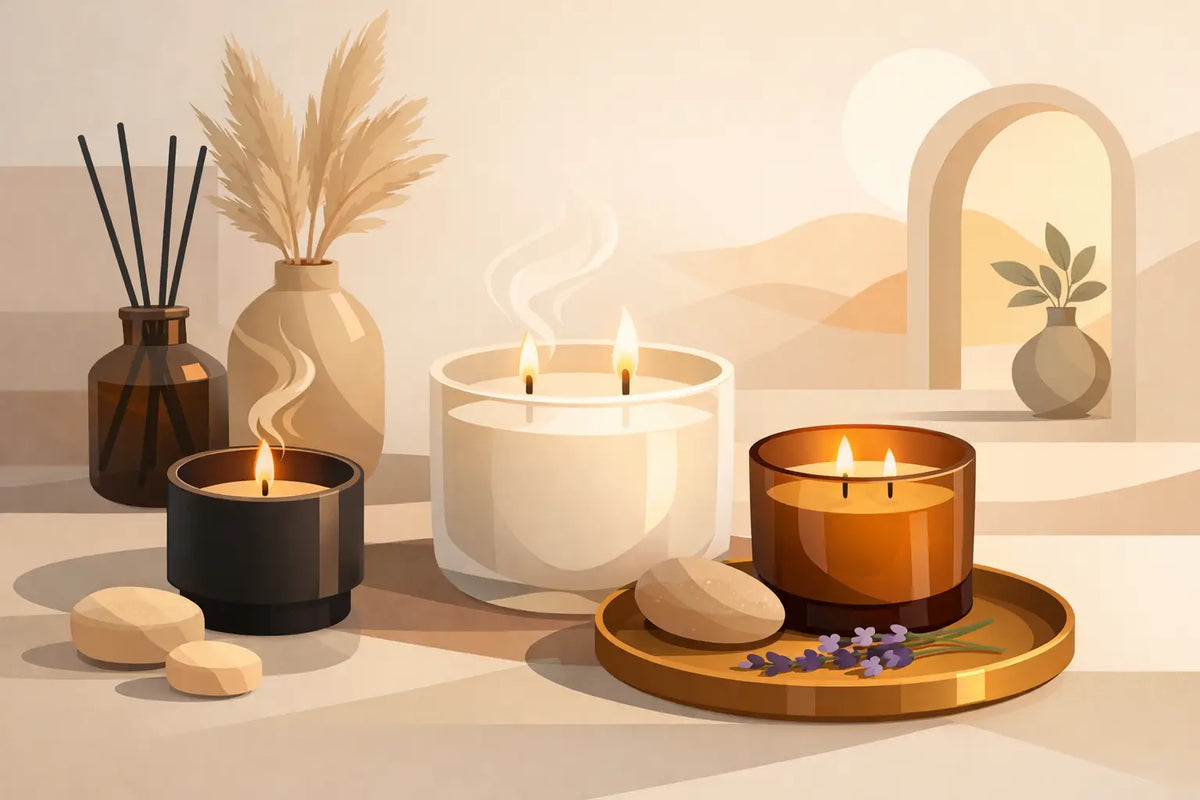
A lit candle on a wooden console, next to a piece of enameled ceramic or in the evening in the living room, can change the way a house is inhabited. Luxury scented candles are not made to mask odors or to fill the air with indiscriminate fragrance. Their mission is more precise: to give character to a room, to sustain a moment of calm, and to transform the everyday act of lighting a wick into a small ritual of beauty.
In a well-cared-for home, aroma is also part of the decorative language. Just as a kilim rug adds depth underfoot or a linen textile softens the light, a well-chosen fragrance leaves a silent, memorable impression. It is not seen, but it defines the atmosphere. And, when well composed, it lingers in memory long after the flame has gone out.
What sets luxury scented candles apart
Authentic luxury does not reside solely in a beautiful container or an elegant label. It is recognized in the quality of the raw material, in the balance of the perfume, in the pouring process, and in the way the candle burns. An excellent piece offers an enveloping diffusion without being invasive, maintains the integrity of its aroma throughout the burn, and transforms its container into an object worthy of keeping.
The wax is the first indicator. High-end formulas often opt for vegetable waxes, such as soy, coconut, or rapeseed, or for carefully developed blends to achieve a clean and uniform burn. Paraffin is not necessarily synonymous with low quality, but a poorly cared-for composition can produce soot, burn too quickly, or distort the most delicate notes of a fragrance. In a refined candle, the wax acts as a discreet support: it allows the perfume to express itself clearly, without overpowering.
The fragrance deserves the same attention. A good indoor perfume has structure, evolution, and nuances. It can open with luminous citrus, reveal a floral, herbaceous, or spicy heart, and settle on a base of woods, amber, vanilla, or soft musks. This olfactory architecture avoids the flat and artificial effect of overly sweet or excessively intense aromas.
The wick also matters. Quality cotton, wood, or braided fibers must correspond to the diameter of the container and the composition of the wax. A poorly chosen wick forms tunnels, drowns the flame, or overheats the glass. A well-calibrated one allows for a homogeneous wax pool and a serene, stable, and luminous flame.
Choosing the scent according to the room
Not all rooms demand the same olfactory presence. The choice should accompany the use of the space, its materials, the light it receives, and the desired prolonged sensation. The goal is not to perfume every corner with a different fragrance until the house is saturated, but to create a subtle continuity between environments.
Living room: woods, resins, and amber notes
The living room admits perfumes with more depth. Cedar, sandalwood, soft leather, amber, incense, black pepper, or ripe fig provide an intimate elegance, especially in the evening. In Mediterranean-inspired interiors, fig leaves, olive, sea salt, and warm woods naturally dialogue with vegetable fibers, aged copper, and artisan textiles.
It is advisable to measure the intensity according to the square meters. In a large living room, a multi-wick candle may make sense. In a small room, a single wick and a more transparent fragrance will be enough to maintain sophistication without overloading the environment.
Bedroom: white flower, linen, and soft woods
The bedroom needs aromas that invite slowing down. Quality lavender, iris, neroli, powdery rose, white tea, cashmere, or creamy sandalwood build a sense of refuge. Here it is preferable to avoid overly sweet or dense compositions, unless the space is also used as a dressing room or reading area.
A candle does not have to remain lit for hours to fulfill its purpose. Thirty or forty-five minutes before bedtime are enough to perfume nearby textiles and prepare the room. It should always be extinguished before sleeping: the wellness ritual is only complete when accompanied by attention and safety.
Bathroom and hallway: clean with personality
In the bathroom, botanical and fresh notes work: eucalyptus, bergamot, rosemary, spearmint, orange blossom, or tea. It is not about recreating a conventional clean smell, but about suggesting a more complex, almost mineral freshness. A ceramic or smoked glass container on a tray with cotton towels transforms a simple routine into a private hotel scene.
The hallway, for its part, appreciates a recognizable aroma that announces the identity of the house. Noble citrus, neroli, and light woods are a safe choice. A too intense fragrance can be exhausting for those coming and going; a luminous composition, on the other hand, leaves a precise and distinguished welcome.
The container also tells a story
In luxury scented candles, the container is not a disposable wrapper. Blown glass, artisanal ceramic, brass, alabaster, or porcelain turn the piece into part of the decoration even when not lit. This detail takes on special importance in homes where objects are chosen for their presence, their origin, and their ability to last.
A candle in Ottoman-inspired porcelain can provide an ornamental note on a dresser. An amber glass vessel fits with a library or a side table with contemporary lines. A copper piece, provided it has been designed to resist heat, adds a warm patina in a dining room set for a long after-dinner conversation.
The criterion should not be only aesthetic. Thick, well-finished containers help distribute heat better, while a lid protects the surface from dust and preserves the fragrance between uses. When the candle is finished, the container can be cleaned and reused as a small vase, pencil holder, jewelry box, or brush container. It is a simple way to extend the life of a beautiful object.
How to care for a candle so it burns well
A quality candle deserves careful use. The first burn is decisive: it must be kept lit long enough for the top layer of wax to melt almost completely. This prevents tunneling, that central hollow that wastes product and shortens the candle's useful life. Depending on its size, this first lighting may require between two and four hours.
Before each use, trim the wick to about five millimeters. The flame will be cleaner, the container will accumulate less soot, and the perfume will diffuse better. If the wick curls or has a small dark deposit at the tip, carefully remove it when the candle is cold.
Place it on a stable surface, away from drafts, curtains, and flammable materials. Avoid lighting it for more than four hours continuously and never leave it unattended. If it is a multi-wick candle, light them all so that the wax melts evenly. These are minimal gestures, but they make the difference between consuming a candle quickly and enjoying it as a long-present piece.
More than aroma: an intimate signature
A house is not built all at once. It is refined with layers: the texture of a blanket, the irregularity of a handmade vessel, the light on a whitewashed wall, and that perfume that appears when closing the door at the end of the day. That is why it is advisable to choose one or two reference fragrances and let them become part of the home's memory.
It can be a blend of fig and cedar for autumn afternoons, orange blossom and bergamot for spring, or amber and incense for conversation nights. There is no universal choice: it depends on the light, the materials, the people who inhabit the house, and the type of calm that is desired to create.
Lighting a candle should not be a gesture reserved for visitors or for an exceptional occasion. Do it when you prepare a simple table, when you return from an intense day, or when you want the living room to feel like yours again. What others call decoration, in a home with a soul becomes a legacy: an atmosphere that speaks of you even before you say a word.


