


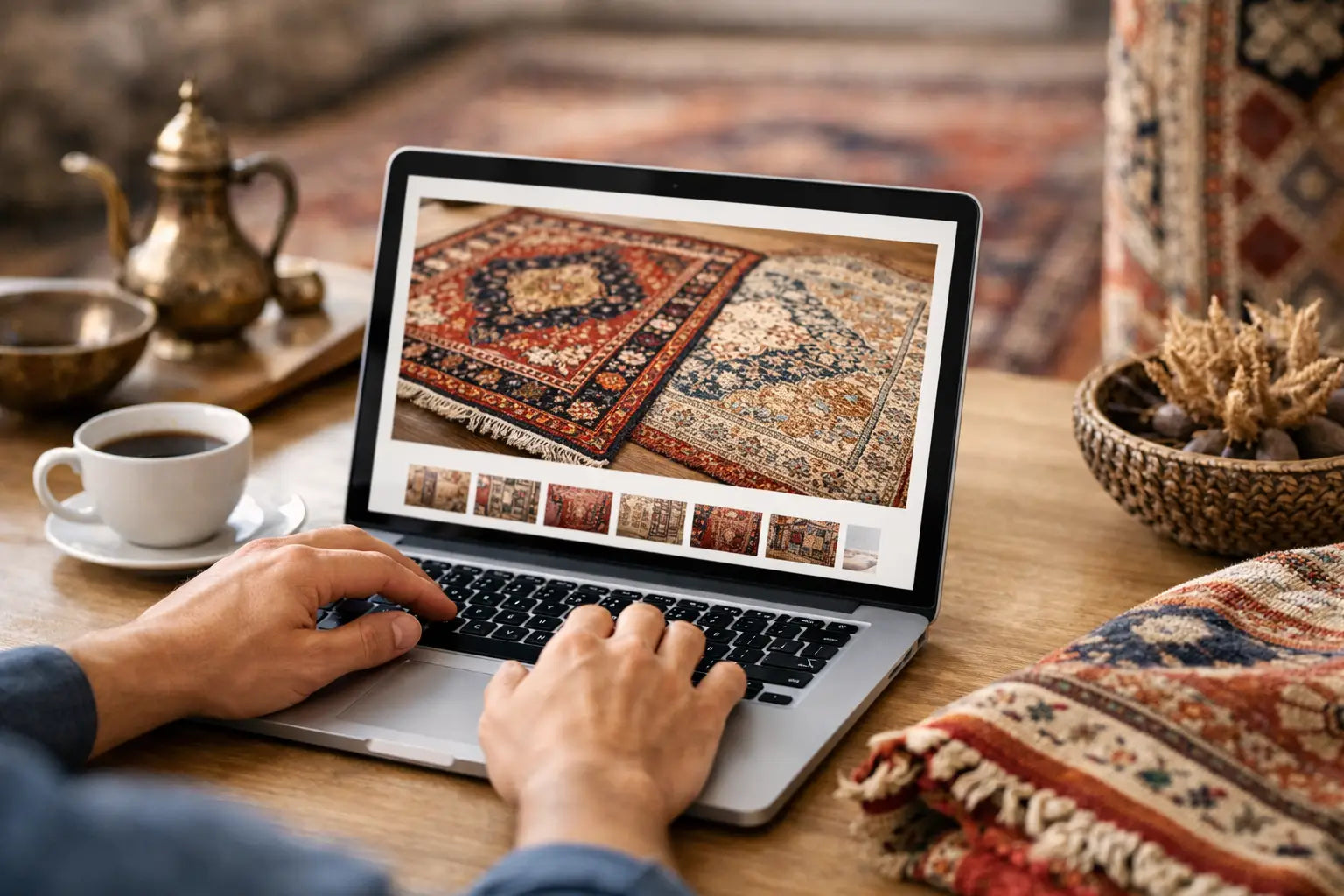
A rug can change the emotional temperature of a room before you have even chosen the art, the lighting or the cushions. That is why so many discerning buyers begin their search for authentic Turkish rugs online - not simply to cover a floor, but to bring depth, memory and character into a home that wants to feel lived in, layered and quietly exceptional.
There is, however, a difference between buying a Turkish rug and buying an authentic one. Online, the language of craftsmanship is often borrowed too loosely. Pieces are described as handmade when they are only hand-finished. Designs are called vintage when they are merely distressed. Provenance is implied rather than stated. For a buyer with a trained eye, or one furnishing a home with intention, those distinctions matter.
Why authentic Turkish rugs still matter
An authentic Turkish rug carries more than pattern. It carries regional identity, artisanal knowledge and a way of making that has been refined over generations. In Anatolia, weaving traditions developed village by village, each with its own palette, symbolism and structure. A rug from one region may feel bold and geometric, while another has a more lyrical rhythm, softer borders or finer knotting.
That heritage is part of the appeal, but so is the atmosphere these rugs create. They ground a room without making it feel heavy. They add age without artifice. In a pared-back coastal interior, they stop minimal spaces from becoming cold. In a more layered home, they act as the one piece that makes everything else look more considered.
This is also why authentic rugs tend to outlive trends. A well-made Turkish rug does not rely on the mood of a season. Its beauty comes from material honesty, balanced design and the visible hand of the maker. Those qualities age well, both aesthetically and practically.
What to look for when shopping authentic Turkish rugs online
The first question is always provenance. A trustworthy seller should be able to tell you where the rug was made, whether it is vintage or newly woven, what fibres were used and, ideally, which workshop or weaving tradition it comes from. If the description stays vague and leans only on mood words such as timeless, bohemian or rustic, that is usually not enough.
Materials matter just as much. Traditional Turkish rugs are commonly made in wool, cotton or silk, sometimes in combination. Wool is prized for resilience, warmth and depth of colour. Cotton often appears in the foundation. Silk is more delicate and luminous, better suited to lower-traffic settings or collectors seeking refinement over utility. A rug described as Turkish but made largely from synthetic fibres deserves a closer look. It may still be decorative, but it is no longer operating in the same category of craft.
Construction is another clue. Hand-knotted rugs generally carry the highest artisanal value because each knot is tied individually, creating durability and complexity. Flatwoven kilims are also deeply rooted in Turkish weaving culture and can be every bit as desirable, though they offer a different feel underfoot and a lighter visual weight. Hand-tufted pieces occupy a more modern middle ground. They can be beautiful, but they are not equivalent to a hand-knotted heirloom.
When buying online, photography should do more than flatter. You want clear close-ups that reveal the texture, pile, edges and any irregularities. Authentic handmade rugs are rarely perfectly uniform, and that is part of their charm. Minor variation in colour, motif spacing or shape is not a flaw. It is evidence that a person, not a machine, made the piece.
The details that reveal quality
Quality in a Turkish rug is often subtle. It appears in the lanolin-rich softness of good wool, in naturally nuanced dyes, and in the way motifs sit comfortably within the field rather than looking overworked. A rug can be visually dramatic and still feel composed.
Look closely at the palette. Natural and vegetable dyes often create colours with softness and depth rather than a flat, synthetic brightness. Reds may lean earthy rather than scarlet. Blues can feel mineral, inky or sun-faded. Creams may have warmth rather than starkness. These tones tend to sit beautifully in Mediterranean and European interiors because they respond well to natural light.
The back of the rug can also tell you much. In a hand-knotted piece, the pattern should be visible in reverse, though not identical in finish to the front. The fringe is another small but useful detail. On many traditional rugs, the fringe is an extension of the foundation rather than something stitched on afterwards.
Condition matters too, especially with vintage pieces. Gentle wear can be deeply attractive and often enhances the character of a rug. Structural weakness, brittle fibres, crude repairs or heavy chemical washing are different matters. The best online sellers will be frank about these distinctions rather than hiding them behind romantic language.
Authentic Turkish rugs online and the question of trust
The real challenge of buying authentic Turkish rugs online is not style. It is trust. You cannot run your hand across the wool or see the colours shift as daylight moves across the room. You are relying on the integrity and fluency of the seller.
A good retailer behaves like a curator, not a warehouse. That means careful selection, accurate descriptions and an obvious respect for the origin of each piece. It also means resisting the anonymous bulk-buy approach that has diluted so much of the home decor market. If every rug looks interchangeable, provenance has probably been stripped away somewhere in the process.
This is where a specialist platform can make all the difference. A house such as Casa Serena, which builds its collection around artisan sourcing and regional heritage, offers more than product access. It offers context. For buyers creating homes with permanence and cultural depth, that context is not decorative. It is central to the purchase.
Choosing the right rug for your home
An authentic Turkish rug should feel right for the room, but also for the life that unfolds inside it. A silk-rich piece in a formal sitting room makes sense. The same rug in a family kitchen probably does not. Likewise, a low-pile vintage rug can be ideal under a dining table, while a softer wool piece may be more inviting in a bedroom.
Scale deserves careful thought. One of the most common mistakes in luxury interiors is choosing a rug that is too small, leaving it to float awkwardly in the centre of the room. A generous rug makes furniture feel anchored and architecture feel more resolved. If you are buying online, always check dimensions against your floor plan rather than guessing from styled images.
Colour should be considered in relation to materials, not just paint. Think about limestone, oak, linen, plaster, brass and marble. Turkish rugs are remarkably versatile because their palettes often echo natural materials rather than competing with them. A faded terracotta and indigo rug can bring warmth to pale oak floors. A muted ivory and tobacco design can soften contemporary stone and black iron.
There is also the question of whether you want the rug to lead or to whisper. Some interiors ask for a statement piece with strong geometry or saturated colour. Others are better served by a rug that reveals itself gradually - quieter, more tonal, but no less sophisticated. Neither choice is inherently better. It depends on the room and on your confidence in letting one piece carry the emotional weight.
Why these rugs are worth buying well
Authentic Turkish rugs are not impulse purchases for those who care about interiors. They are foundational objects. They absorb daily life, soften acoustics, influence colour decisions and often become the oldest-looking, most soulful thing in a room.
Buying well also means buying less often. A properly made rug can remain beautiful for decades, and in some homes it becomes part of the inheritance of taste - something moved from one address to another, adapting as life changes around it. That longevity makes the higher initial spend easier to justify, particularly when compared with trend-led alternatives that need replacing after a few seasons.
For many buyers, there is another reason these pieces resonate. In an age of visual sameness, they restore individuality. No algorithm can quite replicate the subtle tension of a hand-drawn motif or the irregular grace of a woven border. Authenticity is visible. It gives a room authority.
The most satisfying homes are rarely built from hurried choices. They emerge piece by piece, through objects that hold their own story and still leave space for yours. If you are looking for authenticity, buy the rug that offers provenance, material honesty and presence - and let it teach the room how to feel.


