


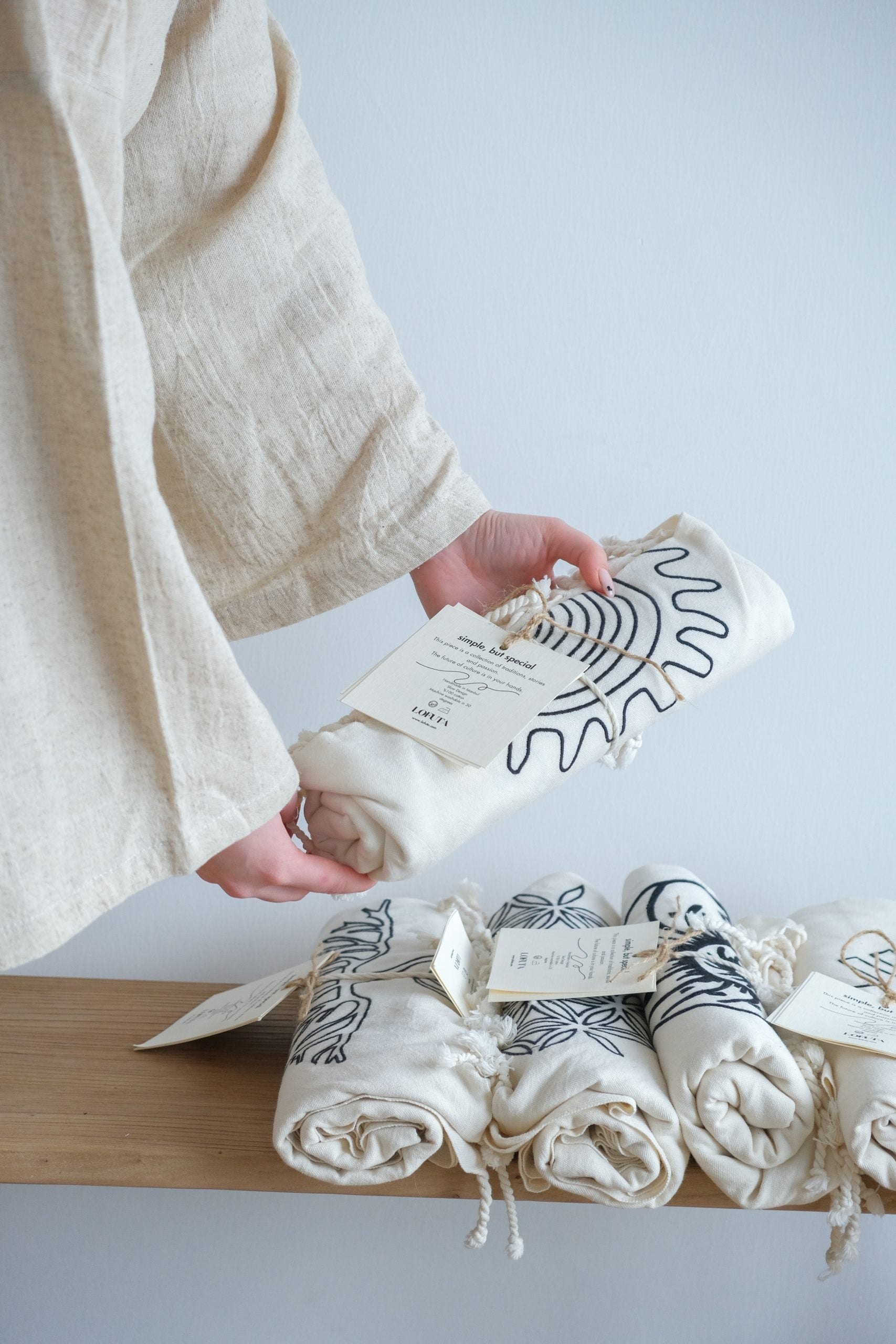
There are products that don't need reinventing because they're already perfect. The peshtemal is one of them. This flat, lightweight towel, woven from pure cotton, has been in continuous use since the 15th century—some historians trace its origins even further—and today it appears in top design magazines, in luxury spas around the world, and in the suitcases of discerning travelers.
The question is: how can something so old remain so relevant?
The origin: the hammam and the Ottoman bathing ritual
The peshtemal originated in Ottoman hammams —public Turkish baths—around the 14th and 15th centuries. The hammam was not simply a place to wash: it was the social center of the community, a space for meeting, purification, and relaxation. In this ritual context, the peshtemal was the garment that wrapped the body: men wore it around their waist; women, from the chest.
Its design met very specific needs. The hammam environment combined steam, hot water, and cold. The towel needed to be absorbent yet lightweight, dry quickly so it could be used several times during the same session, and be large enough to completely cover the body. Plain cotton fabric met all these requirements better than any alternative.
The social symbol: more than just a towel
In Ottoman culture, the peshtemal soon transcended its practical function. By the 17th century, the nobility and the bourgeoisie were commissioning peshtemals with elaborate handwoven designs: the patterns and colors indicated the owner's region of origin, their social standing, and even the occasion for which it had been made.
It was customary to give a peshtemal as a gift at weddings and births. The quality of the fabric and the complexity of the design were a declaration of affection and status. In some regions, peshtemals were even used as currency in trade.
This symbolic dimension has never completely disappeared. Even today in Türkiye, a quality handcrafted peshtemal carries the weight of a meaningful gift, not a generic object.
Why Turkish cotton is different
The Turkish Aegean region produces some of the world's most prized cotton. Its main characteristic is fiber length : Turkish cotton fibers are longer than those of standard varieties. When spun, they produce softer, stronger yarns that are less prone to fraying.
The result in a peshtemal is twofold: on the one hand, remarkable absorbency despite its thinness; on the other, exceptional durability. Unlike conventional terry towels, which tend to lose softness with use, the Turkish cotton peshtemal becomes softer with each wash.
This process of progressive improvement is one of the reasons why those who try a peshtemal rarely go back to anything else.
The peshtemal today: versatile like no other textile
The functionality of the modern peshtemal goes far beyond the bathroom. Its lightness and size make it one of the most versatile textiles available:
✦ Beach or pool towel: takes up a fraction of the space of a terry towel and dries in minutes in the sun.
✦ Pareo or sarong: large peshtemals are wide enough to wrap the body completely and elegantly.
✦ Lightweight travel blanket: perfect for airplanes, breezy beaches or summer nights.
✦ Decorative element: folded over an armchair, a beach chair or the back of a bed, its texture and colors provide immediate visual warmth.
✦ Bath towel for daily use: especially in warm climates like the Mediterranean, its quick drying prevents the moisture and odor that thick towels accumulate.
The Mediterranean summer and the peshtemal: a natural combination
If you live on or spend your summers on the Mediterranean coast, a peshtemal isn't just a whim: it's the logical solution to the climate. In 35-degree heat and humidity, a thick terry towel is uncomfortable, takes hours to dry, and easily develops odors. A peshtemal dries in the sun in twenty minutes and is ready to use again.
Furthermore, its minimal weight and ability to fold into a small package make it ideal for carrying in a beach bag or hand luggage. A single piece can serve as a towel, picnic blanket, and sarong all day long.
How to distinguish an authentic peshtemal
With the global popularity of the peshtemal, industrially produced imitations made with lower-quality cotton have proliferated in other countries. There are some key ways to identify an authentic peshtemal:
✦ Flat weave, not terry cloth: the traditional peshtemal is made of plain weave or with small decorative loops, never of conventional towel terry cloth.
✦ Long-staple cotton: It feels soft and cool, not rough or synthetic. It should drape smoothly.
✦ Woven fringes, not sewn: In quality peshtemals, the fringes are the natural result of the fabric's finish, not a strip added later.
✦ Turkish origin: the cotton from the Turkish Aegean and the weaving tradition of regions such as Denizli or Buldan are a guarantee of authenticity.
A gift with a story: the peshtemal in the culture of gift-giving
In a world saturated with generic objects, giving a handcrafted peshtemal as a gift carries a distinct meaning. It is an object with centuries of history, made from an exceptional material, useful in everyday life, and beautiful when simply resting on a chair or hanging from a bathroom hook.
It's the kind of gift that the person receiving it would never have bought for themselves—and that, once they have it, they can't imagine not having.
✦ Casa Serena's peshtemals are selected from Turkish artisan workshops that work with long-staple cotton and traditional weaving techniques. Each design reflects the regional heritage of its place of origin.
Six centuries of hammam in a textile. That is the peshtemal.


